Vacuum Hose Diameter Compatibility Chart: Common Sizes at a Glance
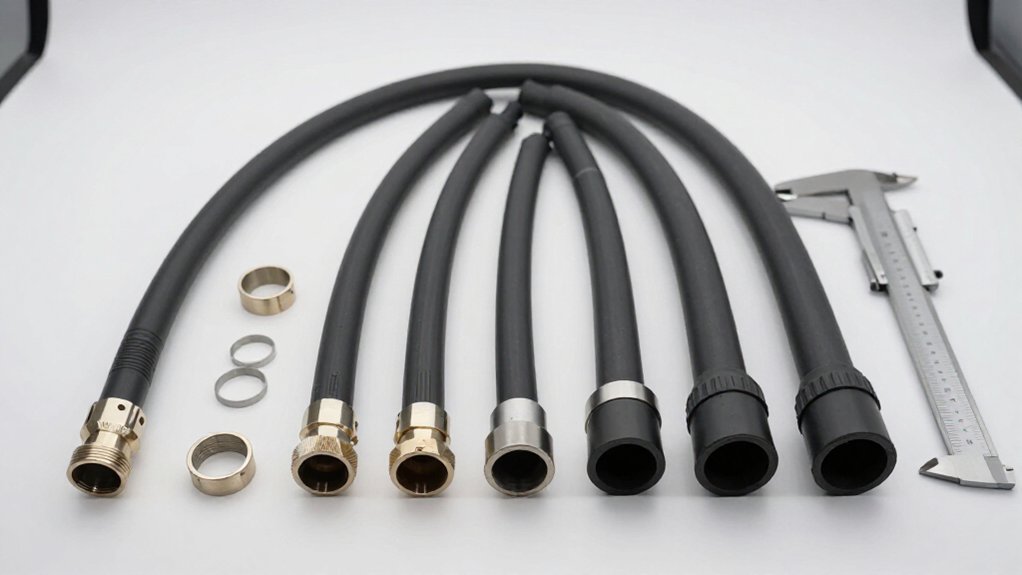
Use this quick crosswalk after measuring the actual connection:
1-1/4-inch hose matches roughly 31–32 mm, 1-7/8-inch matches 47–48 mm, and 2-1/2-inch matches about 63–64 mm. Metric extractors may use 27, 36, or 36–48 mm ports.
Confirm both hose ID and OD with calipers: ID determines airflow, while OD determines clearance. Check wall thickness, adapter geometry, engagement depth, vacuum rating, bend radius, and hose condition before routing.
Continue for guidance on sealing, grounding, and fit verification.
Match Diameter to Fittings
Start by matching the hose’s inner diameter (ID) and outer diameter (OD) to the fitting or dust-shoe port. Measure the port and hose cuff with calipers; don’t rely solely on nominal labels, because manufacturer dimensions vary. Choose an adapter that matches the connection geometry: use an ID-over style when the hose slips over a spigot, or an OD-inside style when the hose enters the fitting.
Test the assembled joint before routing the hose. Confirm it seats fully without kinks, major gaps, or side loading. Seal adapter interfaces with suitable gaskets or clamps when the system requires leak-tight operation.
Check both ends after movement; a secure seal should remain stable under vacuum. Keep transitions smooth and avoid multiple restrictive junctions, which can limit evacuation performance.
Inch-to-Millimeter Size Crosswalk
Once you’ve matched the hose and fitting geometry, use the inch-to-millimeter crosswalk to compare nominal inside diameters across imperial and metric specifications. Use these approximate pairings when ordering a hose:
| Imperial nominal | Metric equivalent |
|---|---|
| 1-1/4 in | 31–32 mm |
| 1-7/8 in | 47–48 mm |
A 2-1/2-inch hose corresponds to about 63–64 mm and suits debris. Metric extractors often use 27-mm, 36-mm, or 36–48-mm connections, so don’t assume a rounded equivalent guarantees compatibility. For example, 1-1/4-inch equals 31.75 mm mathematically, but manufacturers may label it 31–32 mm. Treat inch-to-millimeter values as nominal categories, not universal interchangeability.
Compare the size with your equipment’s port standard and the adapter’s specification before you commit to the purchase for your application.
ID, OD, Wall Thickness
Because hose compatibility depends on more than its nominal label, measure the internal diameter (ID) and outer diameter (OD) before selecting a hose or adapter.
Use the ID to evaluate airflow capacity; use the OD to confirm clearance inside a dust shoe, cuff, or adapter. A common 1¼-inch hose may measure about 32 mm ID and 40-plus mm OD, while a roughly 2-inch Shop-Vac hose may measure about 51 mm OD; its ID varies with construction. Don’t assume matching OD means matching performance.
Calculate wall thickness as (OD − ID) ÷ 2, using measurements from the same section. For an adapter, decide whether the hose fits over a spigot or inside a socket, then match the relevant diameter closely. Measure with calipers, avoid corrugated peaks, and check several points for flex-related variation. Record actual dimensions, not just labels such as 1.25, 1.5, or 2.5 inches before purchase or fabrication.
Material and Pressure Ratings
You’ll compare PVC, rubber, silicone, and polyurethane by temperature limits, chemical resistance, and expected service life. Check the hose’s vacuum and pressure ratings, especially for industrial systems, because airtight performance under negative pressure matters as much as diameter.
Choose reinforced, static-dissipative construction when you need greater crush resistance, durability, or dust-control safety.
Hose Material Types
Choose the hose material according to debris type, service life, temperature, and pressure requirements. For dry residential or light-commercial debris, choose smooth PVC; it typically lasts 6–12 months and suits applications without sharp material. For heavier debris or outdoor and automotive cleanup, rubber smooth hose generally provides 18–24 months of service and toughness.
Select silicone smooth hose for wet/dry operation or high-temperature environments; its service life is 24–36 months. For construction and industrial dust, polyurethane (PU) heavy-duty smooth hose offers 36–48 months and improved puncture and wear resistance. If you handle explosive dust, use anti-static PU and verify required conductivity and grounding.
Match the hose’s pressure class to your equipment: residential systems need 30–50 PSI, whereas industrial installations may require 150 PSI or higher.
Pressure Rating Basics
Match the hose’s pressure rating to your vacuum system’s requirements: residential setups typically need about 30–50 PSI, while industrial systems may require hoses rated for 150 PSI or more. Check the manufacturer’s specification sheet and compare its stated negative-pressure range with your machine’s operating requirement.
A hose that can’t tolerate the applied vacuum may collapse, restrict flow, and cause suction loss, even when your filter remains clean. Choose smooth PVC for lighter residential duty, where service life commonly spans 6–12 months. For heavier suction loads or abrasive dust, PU or anti-static PU generally provides a tougher construction and an expected 36–48-month life.
Measure the hose’s inner diameter and verify its pressure range against your vacuum’s specification sheet before buying for reliable operation under load.
Temperature Resistance Limits
Pressure capacity doesn’t define temperature resistance, so check both ratings before selecting a hose. Match the material to your operating temperature, not merely the vacuum diameter. PVC smooth hose suits dry debris and typically lasts 6–12 months, but its narrower temperature tolerance can limit hotter or wetter use.
Rubber smooth hose generally tolerates broader shop conditions and outdoor exposure, lasting 18–24 months. Silicone smooth hose supports wet/dry operation and high-temperature service, commonly lasting 24–36 months. Polyurethane (PU) smooth hose often provides 36–48 months and suits industrial environments; anti-static PU helps where combustible dust requires conductivity.
For residential vacuum work, expect roughly 30–50 PSI. Industrial high-pressure versions may require 150 PSI or more; verify manufacturer temperature and pressure limits for your exact hose’s construction and application.
Reinforcement And Durability
For construction dust and abrasive debris, reinforced smooth polyurethane (PU) hose typically provides 36–48 months of service because its tougher wall resists punctures and wear. You’ll get protection in demanding environments with anti-static PU, especially around explosive dust or sensitive electronics where static discharge creates risk.
Choose a pressure rating that exceeds your vacuum’s operating demand. Residential systems need 30–50 PSI, while industrial high-pressure equipment may require 150 PSI or more. Material changes service life: smooth PVC often lasts 6–12 months, rubber 18–24 months, and silicone 24–36 months under suction and wear.
Inspect reinforcement, cuffs, and surface for cracks, flattening, or abrasion. Compatibility leaks or worn, low-quality hoses contribute to suction loss in 68% of observed cases, so replace compromised sections and preserve performance.
Matching Hose Specifications
When selecting a replacement vacuum hose, choose a pressure rating that exceeds your system’s operating demand: 30-50 PSI is typically sufficient for residential units, while industrial high-pressure applications may require 150 PSI or more. Match material to duty cycle. Smooth PVC for dry debris typically lasts 6-12 months; heavy-duty smooth PU commonly lasts 36-48 months in construction or industrial dust service.
Check the specification sheet for pressure, intended material use, and environmental limits. Choose a smooth, airtight hose rated for negative pressure; leakage or a restrictive bore can mimic weak suction. For explosive dust or flammable settings, specify anti-static PU and verify grounding requirements. Before buying, measure hose ID and connector dimensions, then confirm the replacement’s pressure and material ratings suit the application precisely.
Check Coupler Engagement Depth
A coupler can match the hose diameter yet still leak if the hose isn’t inserted to the required engagement depth. Check the coupler for an insertion mark, then push the hose to the reference. Use the engagement dimension specified for your adapter design, not the nominal 1-1/4-inch, 1-7/8-inch, or 2-1/2-inch diameter alone.
When you use an adapter, inspect its stop or taper. It mustn’t bottom out early, leaving the hose engaged, especially when a 48 mm mount connects to a 2-1/2-inch hose.
After coupling, run an evacuation test and watch whether vacuum holds steadily. A drop indicates a leak or insufficient insertion. If evacuation weakens at vacuum levels, verify engagement depth before blaming an underpowered pump; poor sealing can restrict flow like a choke.
Static Charge and Grounding
Static charge can become a safety hazard, so select an anti-static PU smooth vacuum hose for explosive dust or flammable-material environments. Its smooth interior reduces cling points where debris can accumulate and support charge or discharge during suction. For high-risk dust, prioritize the anti-static designation over diameter alone, then verify the manufacturer’s conductivity or surface-resistivity specification.
When you change between 1.25-inch and 2.5-inch central-vacuum connectors, confirm dimensional fit and grounding compatibility. Don’t assume a conductive-looking hose dissipates charge: follow the installation instructions, bond conductive components, and connect the grounding path to an equipment ground. Check continuity after assembly and during service, especially if cuffs, adapters, or repairs interrupt the conductive route. A sized, grounded hose helps you control ignition risk without sacrificing extraction performance.
Wet-Dry Vacuum Port Sizes
Because wet-dry vacuum ports vary by model, measure the connection with calipers rather than relying on the labeled size; common ports are approximately 1.25 or 2 inches, while some HVAC-style setups use 3/8-inch hose.
Match hose ID to port opening. A smaller hose creates restriction, so a 1/4-inch-class line on a 1.25- or 2-inch port can slow evacuation and reduce performance. For HVAC work, 3/8-inch hose reduces restriction near 2,000 microns.
If sizes differ, choose an airtight adapter: use a snug push-fit or tapered friction-fit design based on measured port ID or hose cuff. Don’t trust labels; brands use different inch conventions. Confirm adapter specs, seat fully, and seal joint so leakage doesn’t erode suction. Preserve port bore with smooth transitions to maintain airflow.
Inspect Crushed Hose Sections
Inspect the entire hose for crushed or flattened sections, then feel for soft spots and kinks where the internal diameter may collapse. Even a short squeeze point can sharply restrict airflow and reduce evacuation performance. Check especially near the pump end, dust-shoe or detachable connector, and each adapter junction, where a restriction can make a capable vacuum feel underpowered.
- Compare the suspect section with an undamaged section.
- Measure both inside diameters with calipers.
- Treat any measurable reduction as added flow resistance, especially under deeper vacuum.
- Replace or reroute the hose if it won’t regain its original shape.
A collapsed 1-1/4-inch (31–32 mm) bore loses proportionally more area than a larger 2-1/2-inch (63–64 mm) hose for the same deformation. Confirm it stays round; retest suction.
Check Bend Radius Clearance
Before you route the hose, verify its minimum bend radius and leave enough clearance around elbows and fittings to prevent kinking. Measure the relaxed hose ID and follow the manufacturer’s minimum radius; don’t force a 1-1/4-inch or 1-7/8-inch hose through a sharp turn. For long runs, choose a smoother, larger bore when practical, because it tolerates rising resistance better.
- Keep couplers and adapters outside tight bends.
- Support elbows so their weight doesn’t collapse the hose.
- Confirm clearance prevents crushing against walls or equipment.
- Recheck routing if evacuation slows below 2,000 microns.
A kink reduces internal volume and can make your vacuum pump seem underpowered, especially during the final pull below 500 microns.
If performance falls, correct bend radius and routing before replacing the pump.
Conclusion
Use the chart as a starting point, then verify every connection with actual measurements. Match the hose’s inside diameter to the fitting, confirm outside clearance, and account for wall thickness, material, pressure, bend radius, and coupler engagement.
You shouldn’t force mismatched parts or ignore crushed sections. For wet pickup, static control, or grounding, follow equipment requirements. If dimensions remain uncertain, measure both components and choose a properly rated adapter before putting the vacuum into service.