Shop Vac Filter Compatibility Chart: Cross-Reference Sizes at a Glance
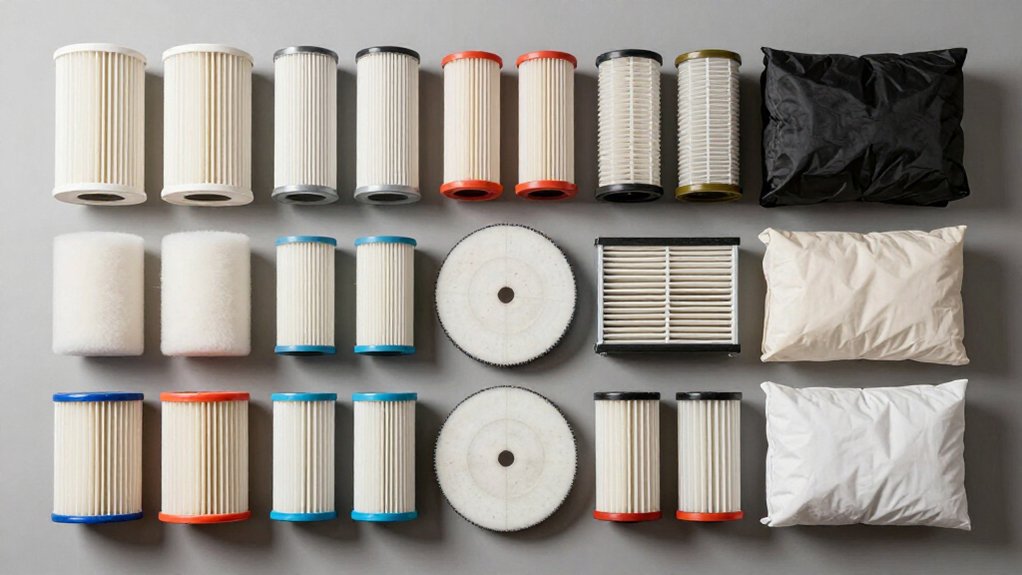
Use your vacuum’s exact model and filter code—not gallon capacity alone—to choose a compatible Shop-Vac filter.
For 5–25 gallons, cartridge 90304 and foam sleeve 90585 fit across the range, while bags vary: 90661/90671 fit 5–8 gallons, 90662/90672 fit 10–14, and 90663/90673 fit 16–25.
Choose pleated cartridges for dry debris, HEPA media for finer particles, and foam sleeves for liquids.
Verify gaskets, Qwik Lock fit, and reusable discs; more small-filter and specialty-bag guidance follows below.
5–25 Gallon Filter Matches
For Shop-Vac units from 5 through 25 gallons, you’ll use the same cartridge filter (Catalog No. 90304) and foam sleeve (Catalog No. 90585); only the disposable bag options change by tank size. For 5-, 6-, and 8-gallon units, select standard collection bag 90661 or high-efficiency bag 90671. For 10-, 12-, and 14-gallon units, use collection bag 90662 or high-efficiency bag 90672.
For 16-, 18-, 20-, 22-, and 25-gallon units, choose collection bag 90663 or high-efficiency bag 90673. You can use reusable dry filter 90107 across every listed capacity. Before ordering, verify your vacuum’s tank capacity and documentation, then confirm catalog number. This cross-reference keeps cartridge and foam components consistent while matching bag fit to unit’s capacity, reducing ordering errors and maintaining collection performance.
Filter Type by Gallonage
After matching cartridge and foam filters to your vacuum’s capacity, identify the disposable bag assigned to that gallon range. Check the model number and collar before ordering; capacity alone doesn’t guarantee a correct fit.
| Capacity | Bag | Check |
|---|---|---|
| 1-1.5 gal | Type A | Model fit |
| 2-4 gal | Type B/LL | Verify |
| 5-8 gal | Type E/H | Best for fine dust |
For 5-8 gallons, use Type E for general debris or Type H for finer dust. For 10-14 gallons, select Type F or higher-efficiency Type I.
For 12-20 and 15-22 gallons, choose tear-resistant bags or Type G/J, including HE versions. Verify inlet and throat against the OEM chart. Replace bags when airflow drops or capacity is reached. For 4-gallon units, Type LL balances capacity; some models require wet provisions for safe wet pickup.
Cartridge, HEPA, Sleeve Definitions
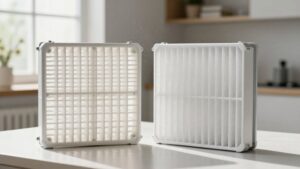
Cartridge, HEPA, and foam-sleeve filters serve different filtration and pickup requirements. You use a cylindrical cartridge for dry pickup; its pleated media traps dust and debris while providing substantial surface area. Quick-lock attachments, such as Qwick Lock, let you install or remove it inside the drum.
A HEPA filter uses finer media for extremely small particles. RIDGID HEPA-rated material captures 99.97% of particles measuring 0.3 micron and larger, although that rating doesn’t necessarily indicate EPA or RRP certification.
You use a foam sleeve for liquid pickup; its open-cell structure helps keep debris away from the motor and blower. Don’t use a dry cartridge for wet work. For finer dry dust, choose HEPA-class or multilayer media. Disposable bags collect dry debris; they’re not filter media.
Model-Specific Filter Codes
Locate your vacuum’s model number, then match it to the manufacturer’s official filter code rather than relying on brand or capacity alone. For 3-4.5-gallon RIDGID units, compare VF3400, VF3500, VF3600, and VF3700 by media type and intended use.
You’ll also need to verify series, dimensions, sealing surfaces, and wet/dry suitability before accepting a replacement.
Locate Your Model Number
Check the model label on the vacuum housing or consult the owner’s manual before selecting a filter, since Shop-Vac and RIDGID filter codes are model-specific.
Look for a rating plate near the motor head, power cord, or tank handle. Record every character precisely, including hyphens, suffixes, and leading zeros; a single digit can identify a different filter family.
Clean dust from the label and use a flashlight to reveal faded printing. If the sticker’s missing, inspect the manual’s cover, parts diagram, warranty paperwork, or original packaging. Don’t rely on tank capacity alone, because similar gallon models may use different installation systems and media requirements.
For RIDGID, record the complete model designation before noting whether the vacuum uses Qwick Lock mounting. Save it.
Match Official Filter Codes
Once you’ve recorded the complete model designation, match it to RIDGID’s official filter code rather than relying on tank capacity or appearance. For RIDGID 3.0 to 4.5-gallon vacuums, select VF3400 for everyday dry debris: its one-layer pleated paper media is washable, reusable, and uses Qwik Lock. Choose VF3500 for fine dust; its three-layer, double-pleated media captures 99% of particles ≥0.5 micron and is washable.
For allergen work, use VF3600, a five-layer HEPA-rated pleated paper filter capturing 99.97% of particles ≥0.3 microns. It’s not EPA/RRP-certified HEPA. For high-volume liquid pickup only, choose wet-only VF3700: its resin-core foam is water-cleanable, reusable, and installs securely with Qwik Lock.
When checking other brands, match type or kit codes: Shop-Vac Type U/AA cartridges and Type D fine-dust bags, not photographs.
Decode Size Compatibility
Because RIDGID filter codes are tied to vacuum capacity, match the code to the model’s documented 3–4.5-gallon size range, not to the filter’s appearance.
For a RIDGID 3–4.5-gallon wet/dry vacuum, verify the capacity before selecting a VF code. VF3400 identifies the washable, reusable one-layer pleated paper filter for everyday dirt, sawdust, and typical debris. VF3500 designates the washable, reusable three-layer fine-dust filter, rated to capture 99% of particles measuring ½ micron and larger. VF3600 specifies the five-layer allergen pleated paper filter for dry pickup, capturing 99.97% of particles 0.3 microns and larger, though it’s not EPA/RRP certified.
For high-volume liquid pickup only, choose VF3700, a foam filter that shields the motor and blower from water-borne debris. If your vacuum falls outside, verify capacity first.
Compare Filter Series
RIDGID’s VF filter codes identify model-specific filtration options for 3.0–4.5-gallon vacuums, so you’ll need to match the code to both the vacuum’s capacity and the debris type. Choose VF3400, a one-layer pleated-paper filter, for everyday dirt. Select VF3500 when you’re collecting superfine dust; its three-layer media captures 99% at ½ micron and larger.
For finer particulate control, VF3600 uses five-layer pleated paper and captures 99.97% of particles 0.3 microns and larger, although it isn’t EPA/RRP certified. For liquid pickup, choose VF3700, a wet-only foam filter that helps keep water-borne debris away from the motor/blower.
Compare these codes by filtration class, not brand alone: everyday, fine-dust, HEPA-rated, and wet applications require different series. Don’t assume one VF filter fits every model in this capacity range.
Verify Replacement Fit
How do you verify a replacement filter’s fit? Match your vacuum’s capacity and model-specific code, not merely its brand. For RIDGID 3.0 to 4.5-gallon units, confirm the application: VF3400’s one-layer media handles everyday dirt, while VF3500’s three-layer media captures 99% of particles at 1/2-micron and larger.
If you need allergen-style filtration, choose VF3600, rated 99.97% at 0.3-micron and larger, though it isn’t EPA/RRP certified HEPA. For wet pickup, use VF3700, the wet-only foam filter.
For Shop-Vac, verify the model’s Type or cartridge code and gallon range before ordering. Check whether you need U or AA cartridge types. For bags, Type B fits 2 to 2.5-gallon units, Type D suits 4-gallon high-efficiency models, and Type F fits 10 to 14-gallon vacuums. Confirm collar diameter, height, and wet/dry designation to prevent bypass.
Account for Small Filters
Small-vac filters require their own compatibility check rather than the standard cartridge-size assumptions used for larger units. Treat these models as a separate cross-reference group, alongside, not within, the 4–25 gallon categories. Start your search with the “Small Filters” listing and use catalog numbers as your primary size gate. Cartridge Filter 90398 and Foam Sleeve 90526 are the key matching pieces for this group; verify that your vacuum’s model documentation calls for one of them before ordering.
If you need extra-fine particulate capture, check whether HEPA Filter 90341 is specified for your unit. Don’t infer compatibility from brand, appearance, or a seemingly similar cartridge. Match the exact catalog number first, then confirm the listed model application and physical fit to prevent an incorrect installation error.
Wet-Pickup Sleeve Limits
When you’re picking up large amounts of water with a RIDGID 3.0- to 4.5-gallon wet/dry vac, use the VF3700 foam sleeve; it’s designed for high-volume liquid pickup, not heavy fine-dust debris. The open-cell sleeve is a wet-application filter, and its added protection helps keep water-borne debris away from the motor and blower wheel.
Choose this sleeve only for liquid or wet jobs. Don’t substitute a dry filter when collecting water; unsuitable media can clog, collapse, or permit moisture-related damage. After use, clean the VF3700 with water, then let it dry according to the manufacturer’s guidance before storage.
Verify that the sleeve seats securely and that the filter assembly matches your RIDGID model. Correct wet-rated compatibility preserves airflow, protects internal components during repeated wet pickup.
18-Gallon Fine Dust Bag
An 18-gallon fine dust bag captures extra-fine dry debris, such as sanding dust, and helps keep your shop vacuum’s drum cleaner. Install it inside the tank for dry pickup, where its fine media improves dust containment and limits residue on the drum.
It’s intended for shop vacuums in the 16–22-gallon range, so verify your vacuum’s rated tank capacity before ordering. Check the bag Type and your manufacturer’s model or part-number cross-reference; the “18-gallon” label alone doesn’t guarantee compatibility. Match the inlet opening and throat configuration to the vacuum’s intake to avoid restricted airflow or installation problems.
Use this bag for very small particles from sanding and similar dry work, not wet spills or large water volumes. Choose it only for dry pickup on compatible models.
Inspect Gasket Before Installation
Before installing the filter, inspect its gasket for tears, cracks, warping, missing sections, or embedded debris that could allow dust to bypass the seal. A clean gasket can mate tightly with the drum-side seat.
Check these conditions:
- Confirm the gasket remains continuous around the filter.
- Look for compression, cuts, brittleness, or permanent distortion.
- Remove loose debris without damaging the sealing material.
- Replace any gasket that’s worn, flattened, or damaged.
- After installation, verify the gasket is seated and the filter sits flush.
Don’t rely on a snap-on connection; Qwick Lock or Qwik Lock engagement doesn’t guarantee an airtight seal. If you see a gap anywhere, remove the filter, clean the contact area, and reinstall it before vacuuming. A compromised gasket can release fine dust into the room and reduce filtration performance.
Verify Reusable Disc Fit
After confirming the gasket is clean, uninterrupted, and properly seated, verify that the reusable disc matches your vacuum’s gallon capacity and catalog number; for example, many 5–8 gallon models use catalog 90107. Confirm it’s a reusable dry filter, not a cartridge, HEPA element, or wet foam sleeve; those designs use different seats and applications.
Check that the fastening system matches your model, such as Qwick Lock or Qwik Lock, and inspect the seating surface before operation. The disc must lie flat and lock fully without gaps, or dust can bypass the filter and return to the drum. Clean it and reinstall it in the same orientation, preserving the established edge-to-seal contact.
- Match gallon capacity.
- Confirm dry type.
- Align locking tabs.
- Ensure flat seating.
- Stop immediately.
Conclusion
Use this shop vac filter compatibility chart as a starting point, not a substitute for your model’s manual. Match gallon capacity, filter type, and manufacturer code before installation.
You’ll avoid assuming that similar dimensions guarantee compatibility, especially with small tanks, wet-pickup sleeves, HEPA cartridges, and fine-dust bags. Inspect the gasket, confirm the reusable disc seats correctly, and test the seal.
If any fit remains uncertain, choose the verified replacement listed for your model exactly.