How to Choose a Car Vacuum Cleaner: 7 Specs That Matter More Than Power
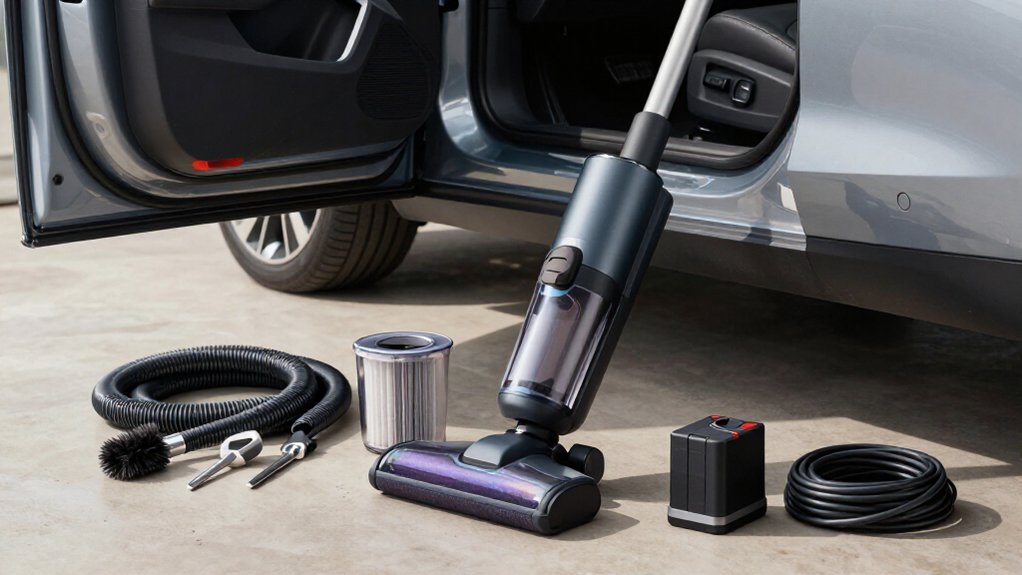
Choose a car vacuum by comparing usable suction in kPa with runtime and bin capacity, so don’t chase peak power alone. Check nozzle reach, hose flexibility, and brush performance for seats, rails, mats, vents, and crevices.
Verify tool-free filter access, washable prefilters, sealed gaskets, and affordable replacements.
Then assess corded or cordless power, 12V access, battery cost, thermal protection, and noise.
The comparisons ahead help you choose wisely and match a vacuum to your car.
Check kPa, Runtime, and Bin
Start with the combination of kPa, usable runtime, and bin capacity**, not peak suction alone. Compare tested performance: a 19-kPa vacuum may deliver only 8–10 kPa in eco mode** and hold its highest suction for roughly 15–17 minutes.
Another reaches just under 14.5 minutes on high, while a max-power model lasts about 6 minutes 36 seconds. Choose the setting you’ll actually use, and judge whether it can finish the job.
Treat kPa as sealed-inlet pressure, not airflow or guaranteed pickup. Nozzle design and restricted airflow change real debris removal. For loose crumbs and dust, eco suction may suffice; sand embedded in carpet mats usually needs peak suction for long enough, with brush agitation. Check bin capacity too: small chambers fill quickly, forcing interruptions during cleaning.
Assess Seats and Crevices
When you assess seats and crevices, prioritize nozzle reach and clearance over peak kPa alone. A tiny crevice tool may enter narrow gaps but can’t handle larger crumbs, so compare hose flexibility and head profile. Test whether the nozzle reaches beneath rails and between cushions.
For footwells and mats, choose roughly 13–19 kPa for crumbs, then add a brush or agitator to loosen sand embedded in fibers. Fabric seats need a brush that breaks the weave; a rubberized or pet tool lifts hair before suction removes it.
Check the bin’s debris path, too: small chambers can clog and interrupt cleaning. Verify runtime in the mode you use. Boost may last only 14–17 minutes, while lower modes can provide 8–10 kPa.
Filter Access and Washability
Choose a vacuum with tool-free filter access, a washable prefilter, and a replaceable primary filter so you can maintain airflow without high upkeep costs. Check that the cartridge lifts out without tools and that its gasket seals fully; a poor fit causes bypass leakage. Rinse washable parts, then let them air-dry for at least 24 hours before reinstalling. Never wet a True HEPA paper filter unless the manufacturer explicitly permits it.
| Filter setup | Practical result |
|---|---|
| Foam prefilter | Traps hair and grit; cheapest upkeep. |
| Washable pleated | Better fine-particle capture; washing eventually degrades it. |
| True HEPA cartridge | Strongest allergen control, but it adds airflow resistance. |
| Disposable fiber | Predictable filtration; recurring replacements prevent recontamination. |
Before buying, verify dimensions, airflow direction, replacement availability, and the recommended service interval.
Corded, Cordless, Wall-Mounted
Choose corded power for steadier suction during long or heavy cleanups, or cordless freedom for quick access to tight spaces without cable management. A wall-mounted unit keeps the vacuum and tools organized, but you’ll need sufficient hose reach for the entire cabin. Match your setup to your vehicle size and cleaning habits, comparing usable suction and real-world runtime rather than peak power alone.
Corded Power Benefits
For long detailing sessions, a corded car vacuum delivers steadier suction because it isn’t limited by battery capacity or charge level. That consistency matters when you’re lifting sand from large floor mats or working through low-pile carpet without a mid-session power taper.
Mains-powered models also suit wet/dry extraction, where sustained airflow helps move liquid and debris through the hose. Compare measured performance using sealed suction, CFM, and airwatts rather than motor wattage alone; manufacturers report these figures inconsistently.
Check independent tests when available, and match the vacuum’s reach and outlet access to your vehicle. A corded unit makes the strongest choice for full interior detailing, repeated jobs, or heavy mats. If your sessions stay brief, its stable output may matter less than setup.
Cordless Cleaning Freedom
Cordless vacuums cut setup time and make it easier to reach cupholders, crevices, and the space under floor mats without managing a cable. You’ll gain practical mobility for quick crumb and sand cleanup, but battery capacity limits your session.
Compare kPa with runtime at that setting, not suction alone. A model may advertise pressure yet spend most of its charge in lower-power Eco mode. Boost mode usually shortens runtime sharply, so estimate performance using your cleaning setting.
Typical cordless models run 15–55 minutes, while removable or dual-battery designs extend jobs and simplify turnaround. Choose a corded vacuum when you’re cleaning large, filthy interiors and need sustained suction without battery fade. For cordless use, prioritize balanced suction, accessible nozzles, a dustbin, replaceable batteries, and charge-time specifications.
Wall-Mounted Convenience
Once you’ve decided between battery freedom and continuous power, the wall-mounting setup determines how quickly you can start cleaning and how far you can reach. Corded wall vacuums provide consistent suction without battery drop, making them practical for quick cabin cleanups. Verify cord length and nozzle design so you can reach footwells, under seats, and the trunk without dragging the unit or limiting access.
Cordless wall-mounted models reduce cable clutter, but runtime depends heavily on suction mode. At maximum power, leading handheld units may last only 11–15 minutes, then switch to lower output. A vacuum might begin near 19 kPa yet settle around 8–10 kPa after its boost period. Also, check debris chamber: compact bins fill quickly, so easy emptying keeps wall-mounted sessions efficient.
Choosing Your Setup
Start with how you’ll clean, not the highest suction number: a cordless handheld is usually easiest to maneuver through a cabin, while a corded model suits longer jobs because its output won’t drop as the battery drains.
Choose cordless if you can finish a cabin pass within its practical runtime, not peak mode. Boost mode shortens endurance, while short reach leaves sand in mats.
Choose corded for footwells, carpets, or vehicles; constant power supports suction, but the cable restricts movement and requires an outlet. A wall-mounted unit offers access for pickups and corded-style power when plugged in. Mount it, checking hose length, tool storage, and outlet access. Match crumbs with convenience; tackle pet hair and embedded grit with reach, airflow, and uninterrupted operation.
Brush Attachments for Vents
Choose soft-bristle or rubberized brushes to protect vent surfaces while loosening dust, and compare flexible designs for reaching slats and corners.
Narrow, angled heads lift debris without wedging like tiny crevice tools can. Prefer detachable brushes for easier cleaning, then use the crevice tool to capture loosened particles.
Soft Bristles Protect Vents
Soft-bristle brush attachments loosen dust from vent fins without scratching plastic or driving fine particles deeper into the openings. Compared with a hard nozzle, a compact brush makes gentler, more consistent contact and lifts residue as you vacuum. Choose one with a modest opening and controlled airflow: it should capture loosened dust without pulling loose trim pieces into the intake or creating a clog.
You don’t need maximum suction for this task. If suction falls in eco or medium mode, let the bristles agitate the dust and use a realistic setting rather than blasting boost power. Check the bin and filter afterward, especially if the intake clogs quickly. Frequent emptying and filter cleaning preserve airflow, helping the attachment perform consistently without stressing vent components.
Flexible Brushes Reach Slats
Flexible brush attachments reach between vent slats and air-grille gaps that a straight crevice nozzle often misses. Choose a combo soft-bristle/upholstery-style brush or flip-down brush: its flexible fibers follow the grille’s contours while loosening embedded dust. You’ll clean more effectively when you agitate each slat first, then switch to suction and remove the loosened particles in one pass.
This sequence reduces re-debris and limits the need to press a rigid nozzle against delicate plastic.
Compare attachment design, not just the included-tool count. The brush should stay secure, flex, and fit common vent spacing. Check the debris path, too: dust-heavy jobs can clog small collection chambers quickly, interrupting airflow and forcing frequent emptying. Choose a design with compliant bristles, a stable connection, and adequate capacity.
Narrow Heads Lift Dust
A narrow crevice head directs airflow into vent gaps, while a soft-bristle or small motorized brush loosens dust packed around the slats before suction removes it. Choose the head according to debris: a slim nozzle handles loose lint and fine particles, while bristles provide agitation when grime is embedded in grooves. This combination works better than a broad nozzle, which may bypass narrow channels and blow dust across the vent.
Check the nozzle’s path, too. A restrictive design can clog quickly, reducing airflow and forcing emptying. Compact handhelds such as the Fanttik Slim V10 APEX fit tight spaces, but reports note its lack of a wide nozzle and difficulty with larger debris. For vent work, prioritize profile, reach, and clog resistance over power.
Detachable Brushes Ease Cleaning
When vent dust is packed into slats or seat seams, a detachable brush lets you agitate it before the vacuum pulls it away. A dedicated crevice tool then focuses airflow on loosened particles. Choose a soft-bristle or upholstery brush for fabric seats, because it breaks up the weave without scraping trim.
Compare the attachment opening, since a wider mouth resists clogging on crumbs better than narrow nozzles. Black+Decker’s Dustbuster illustrates this advantage, while the Dyson V8 Car+Boat’s particularly small crevice tool favors fine dust but can struggle with larger debris. Prioritize a vent-specific set with clear airflow paths, and you’ll finish with fewer passes.
Check that brushes detach easily for rinsing or replacement, and store them onboard so you won’t misplace the right tool later.
Confirm 12V Outlet Access
Confirm that your vehicle has an accessible 12V outlet before choosing a corded car vacuum. Many detail vacuums, including the Chemical Guys DetailVac, rely exclusively on this socket, so check its location and accessibility before comparing models. An outlet near the console may work well, while one behind a covered panel can make cleaning awkward.
Next, compare cord length with your cabin layout. A 16-foot cord, as listed for the DetailVac, may reach across many interiors without unplugging, but measure the distance to the far seat and cargo area. Ensure the plug fits securely; a loose connection can interrupt power delivery mid-clean. If reach remains uncomfortable, choose a cordless design instead. You also can’t avoid cord management as you move around seats and mats.
Replacement Battery Pricing
Battery replacement costs can determine a cordless car vacuum’s long-term value, so check the exact battery part number and whether the manufacturer sells it as an official pack. Compare that price with the vacuum’s current sale price. A removable lithium pack helps when you’re comparing replacements from the manufacturer or retailers, rather than chasing scarce stock for your model.
Estimate ownership cost against your cleaning routine. If you need high-suction minutes for multiple cars, a worn battery can shorten medium- or maximum-mode runtime, especially when suction already declines as charge falls. Check stated service life, charging requirements, and included-pack capacity.
A cheaper vacuum may cost more over time if each replacement approaches the machine’s sale price. Choose readily restockable batteries and budget for expense.
Check Thermal Protection Features
Check for thermal protection that throttles or shuts down the motor before overheating, particularly if you use maximum suction to remove sand, pet hair, or other clog-prone debris. Restricted airflow raises motor temperature, and boost modes drain batteries rapidly as heat builds. Choose a model that regulates output automatically or shuts down safely, then restarts after cooling.
- Read the protection claim. Prefer explicit thermal sensors, overheat shutdown, and restart guidance over vague “high-power” marketing.
- Compare sustained performance. A vacuum rated near 19 kPa may lose output quickly; the Fanttik Slim V10 APEX lasts just under 14.5 minutes on maximum. Look for longer continuous-operation ratings.
- Prevent clogs. Empty it and clean filters; protection limits damage, but it won’t replace maintenance or ensure results.
Measure Decibel Output
Thermal protection limits heat buildup, but you’ll also want to measure how much noise the vacuum produces during sustained use. Check dBA measurements made at the operator’s position, preferably in high-power mode, because greater airflow usually raises noise while shortening runtime.
- Target quiet: Models around 71–79 dBA, such as Fanttik Slim V10 APEX at 71.7 dBA and Monozel at 72.3 dBA, feel less intrusive.
- Compare loud picks: Black+Decker Dustbuster reaches 82.1 dBA, while Dyson V8 hits 83.1 dBA.
- Weigh trade-offs: A slightly louder vacuum may still suit you if stronger suction finishes cleaning sooner.
If you’re noise-sensitive, favor upper-70s readings or lower, but verify peak runtime rather than relying on quiet-mode claims.
Treat dBA alongside suction, since comfort matters only if performance remains adequate.
Conclusion
When you’re choosing a car vacuum, compare useful specifications, not headline power ratings. Check kPa, realistic runtime, bin capacity, and whether the filter is washable and accessible. Match the tool set to seats, crevices, and vents.
Then verify 12V access, battery replacement cost, thermal protection, and noise output. A compact, serviceable model that reaches every surface will outperform a stronger vacuum you can’t conveniently use. Choose one you’ll keep charged, maintained, and stored within reach.