
Choosing a Shop Vacuum for Your Garage: 7 Specs Beyond Just Tank Size
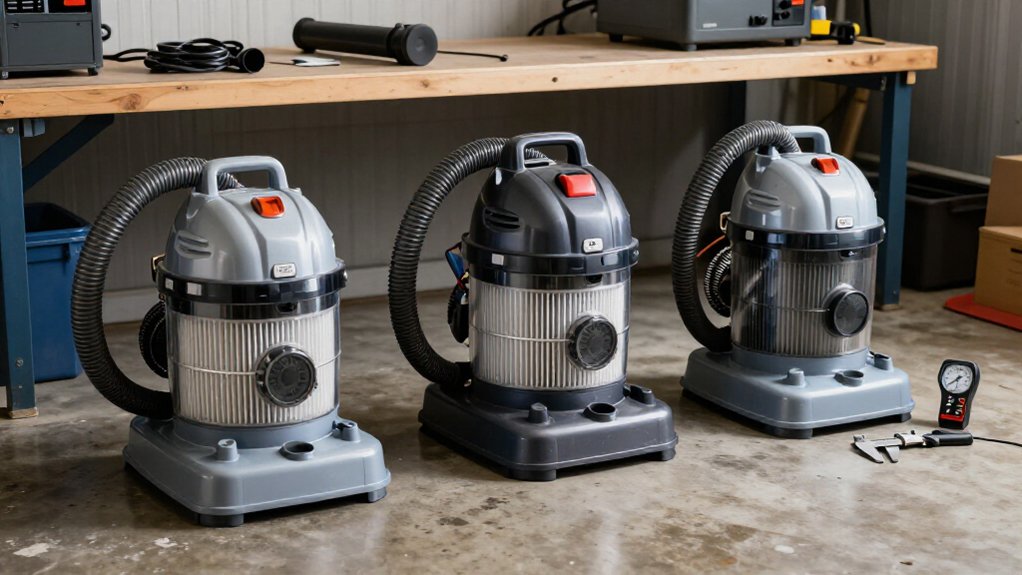
You’ll choose shop vacuums by more than tank size.
Prioritize at least 100 CFM for garage sawdust, then compare water lift for balanced suction.
Match hose diameter to debris: 1¼ inches for fine dust, 1⅞ for general cleanup, or 2½ for chips.
Confirm wet-rated filtration, a pleated cartridge, sealed gaskets, blower capability, adequate hose and cord reach, durable casters and latches, plus warranty and parts support.
These specifications simplify choice, and details help refine it.
Prioritize Airflow Over Gallons
Prioritize airflow in CFM over tank capacity when comparing shop vacuums, because higher airflow moves debris through the hose faster and reduces clogs or missed material. Treat CFM as your primary pickup-speed metric, not gallons or peak horsepower. A large tank only delays emptying; it doesn’t move debris faster.
For garage sawdust, target at least 100 CFM, then favor higher output to keep material moving through the hose.
Check suction in inches of water (in H₂O) alongside CFM. High lift can’t compensate for restricted airflow; the hose can bottleneck despite an impressive rating. The Vacmaster Beast pairs 223 CFM with 94 in H₂O, while the DeWalt DCV581H delivers 10 CFM and 27 in H₂O. Choose balanced specs, so you’ll finish faster with fewer clogs.
Account for Wet Spills
When garage cleanup includes wet spills, choose a wet/dry vacuum with enough tank capacity to handle the job without repeated dumping. A 5-gallon model suits occasional household spills, while a 12-gallon unit gives you more reserve for larger leaks and mixed wet/dry debris.
Remember that capacity adds weight, so balance fewer emptying stops against storage and maneuverability.
Prioritize strong water-lift performance and a drain or convenient emptying design. In timed tests, capable 12-gallon vacuums removed 2 gallons of water in about six seconds, demonstrating efficient wet pickup. Check that the machine includes a wet-rated filter or foam sleeve; using a dry cartridge during liquid collection can damage the filter and restrict airflow.
For gravel or heavier debris, choose a model that maintains suction without hangups. A stainless-steel tank can improve durability when frequent wet use exposes components to moisture.
Hose Diameter and Reach
Choose the hose diameter based on the debris you’ll collect: a 1.25-inch hose delivers higher air velocity for fine dust and detailing, a 1⅞-inch hose suits general garage cleanup, and a 2.5-inch hose moves bulky chips, gravel, and heavy sawdust with less clogging. Match hose length to your workspace: a longer hose reduces repositioning, but friction lowers delivered CFM and vacuum at the tool tip.
Prefer a smooth-bore design for extended runs, and avoid kinks that restrict flow. Measure the inlet’s inside diameter, since manufacturers may use proprietary fittings; adapters can bridge mismatches. Check connector security and hose-wall durability before buying.
| Hose | Best fit |
|---|---|
| 1.25 in. | Detail work and upholstery |
| 2.5 in. | Chips, gravel, and heavy sawdust |
A 1⅞-inch hose remains the practical middle ground.
Blower Ports Versus Suction
Use suction for wet/dry debris removal, and evaluate pickup by hose airflow, CFM, sealed pressure, and hose diameter, not by the rear blower port. Use the blower port to push grass clippings, sawdust, and dust from cracks or tight areas.
When switching functions, connect the hose to the appropriate outlet and verify the filter and attachments match the task.
Suction For Debris Removal
For garage debris removal, you’ll get the best results by balancing suction lift with airflow rather than relying on peak horsepower alone. Check specs in two dimensions. Airflow, measured in CFM, keeps loose sawdust and grit moving through the hose and reduces clogging. Suction lift, listed as inches of water or in H₂O, matters more when you’re lifting dense bark pieces or metal chunks.
Strong benchmarks include 50 in H₂O for heavy pickup; some models reach 94 in H₂O. Don’t compare peak HP alone, because motor rating doesn’t show delivered airflow or lift. A rear blower port can complement suction for pre-clearing, but it won’t capture debris in the tank. Choose a wide hose to limit intake clogs and preserve consistent pickup under load.
Blower Port Applications
When debris is packed into tight corners or along a driveway, a blower port can clear it more effectively than suction through a narrow hose. A blower-mode connection reverses the hose, letting you push dirt, gravel, sawdust, or grass clippings out of recessed areas, behind equipment, and off hard surfaces. Use it when packed dust resists pickup or when a small hose would clog quickly.
This outward discharge can reduce the need to reposition the vacuum repeatedly, improving access during cleanup.
For selection, verify that the unit includes a dedicated rear blower port and a secure hose fitting. A 12-gallon stainless Shop-Vac model, Item #5761311, supports this arrangement for hard-to-reach dirt and clippings. You shouldn’t treat blower mode as a replacement for suction.
Airflow And Pressure
Blower mode pushes air outward to clear debris from crevices, while suction relies on both airflow and pressure to pull material through the hose. When you compare vacuums, check CFM and water lift together. CFM measures the air volume carrying loose sawdust and debris; inches of water (in H₂O) measures lifting force at the nozzle.
A high lift rating can’t compensate for restricted airflow. The DeWalt DCV581H, rated at 10 CFM and 27 in H₂O, demonstrates how strong-looking suction can perform poorly when airflow stays low.
Look for balance rather than impressive numbers. The Craftsman 16-gallon model combines 274 CFM with 50 in H₂O and avoided practical pickup limits. Vacmaster’s 94-in-H₂O rating still needs adequate CFM. Blower ratings describe outward delivery, not suction strength.
Switching Between Functions
A shop vac’s blower port lets you reverse airflow to push dust, leaves, and grass clippings from tight areas instead of collecting them. Use blower mode for dry debris; suction collects wet material through the filter. To switch functions, move the hose from the vacuum inlet to the rear blower outlet, and verify that your model supports both connections.
Check hose diameter and connection style. A locking or Lock-on® hose stays seated during mode changes, preserving airflow. A sealed-pressure rating, such as 67 inches, indicates pressurizing capability, but nozzle design and attachment fit determine blowing performance. Compare specifications with hose length and diameter for reach and control. Don’t treat blower airflow as a substitute for suction pickup; use the correct port for each task.
Fine-Dust Filter Performance
To capture drywall and sanding dust, you’ll need a fine-particle filter with a verified rating, not just high peak HP. Choose a pleated cartridge filter for greater surface area and sustained airflow, preferably with a sealed canister and optional disposable bag.
Check how you’ll clean or replace the filter, since clogging reduces hose suction and lets dust bypass filtration.
Fine Dust Capture
When you’re vacuuming drywall, concrete, or sanding dust, prioritize a sealed fine-dust filter system over peak horsepower or tank size. Fine-dust capture depends on the path: cartridge or foam-sleeve arrangement, gasketed canister, latches, and hose connections.
Any leak can release particles or reduce collection, even when the motor produces suction.
Check how the filter installs, seals, and stays supported during operation. Disposable bags, where available, add containment and simplify cleanup. Avoid models with narrow hose openings if your work produces heavy dust; they can clog frequently, restrict airflow, and weaken pickup.
A vacuum designed for fine-dust work should arrive ready to use, with accessories such as a crevice tool or nozzle. Before buying, verify replacement-filter availability and inspect every connection for a continuous, secure seal.
Filter Rating Matters
Filter quality determines whether fine drywall, wood, or sanding dust stays in the canister or returns to your garage air. Don’t choose a vacuum labeled merely “wet/dry”; check its stated filter rating and fine-particle suitability. A coarse filter can let escaping dust undermine cleanup and indoor air quality.
This specification matters even more on compact 1–2-gallon models, where frequent use, wet/dry switching, and cleanup can make filtration harder to maintain. For larger jobs, match filtration with performance: a Craftsman 16-gallon example delivers 274 CFM and 50 inches of water lift, while robust filtration helps limit clogging and leakage. Look for complete dust-control packages, too. A 12-gallon Shop-Vac example includes a cartridge filter and foam sleeve. Choose a filter that captures fine particles effectively and consistently.
Pleated Filter Design
A pleated fine-dust filter captures more drywall, sanding, and other tiny workshop particles than a basic filter because its folded media provides greater surface area. That larger filtering surface can preserve stronger airflow for longer during continuous fine-dust pickup, reducing the performance drop you may see as particles load the media.
Look for a pleated paper or cartridge-style filter specifically rated for fine dust, not merely a wet/dry label. Wet/dry capability describes liquid handling; it doesn’t guarantee effective containment of sanding fallout. Match the filter to your work: drywall and orbital-sanding dust demand finer filtration than coarse chips or leaves.
Also inspect the vacuum’s canister seal, lid gasket, and filter-housing fit. Even a high-efficiency pleated element can’t prevent escaped dust if air bypasses it.
Cleaning And Replacement
Keeping fine-dust performance consistent starts with using the correct filter setup, typically a pleated cartridge paired with a foam sleeve, rather than a basic wet-only filter. This combination captures drywall, sand, and wood dust more effectively. When comparing models, consider hose output as well as suction: a Craftsman 16-gallon vac reached about 274 CFM and 50 inches of water lift, supporting cleaner surfaces.
For replacement, match the cartridge, foam sleeve, or disposable bag to your model’s housing diameter. An incorrect fit can restrict airflow or increase bypass dust. Before reuse, fully seat the component, inspect the gasket, and check for clogging.
Replace damaged filters promptly. A vac that includes a fine-dust cartridge and bag options lets you switch between jobs, preserving pickup performance while simplifying cleanup.
Outlet Spacing and Cord Length
Plan your shop vac around your garage’s outlet spacing, and choose the longest practical power cord you can—ideally 20 feet, as found on the Shop-Vac 12 Gallon 6.0 Peak HP Stainless Steel model. Measure the route from your primary outlet to the farthest work area, including clearance around an SUV or along the driveway edge.
A 20-foot cord reduces repositioning, but evaluate its combined reach with the hose. Short cords force extension-cord use, increasing setup time and trip hazards. Manage the cord during car, floor, and corner cleanup; fumbling slows quick jobs. Choose onboard storage that limits tangles. If outlet spacing exceeds cord reach, use a properly rated extension cord—never stretch or daisy-chain connections—and verify the cord matches the vac’s load and circuit rating.
Warranty and Parts Availability
Cord reach affects daily convenience, but warranty coverage and replacement-part access determine how well your shop vac serves you over time. Check the warranty’s length, exclusions, registration requirements, and repair process before buying. A Shop-Vac 12 Gallon #5761311, for example, lists a limited lifetime warranty, while coverage varies by brand and model.
Treat warranty duration as one value indicator, not a substitute for serviceability.
Confirm cartridge filters, foam sleeves, and compatible disposable bags remain available. An included filter system lets you replace clogged components without improvising. Verify hoses, extension wands, and nozzles or kits are sold for your model.
Small 1.5-inch crevice and gulper tools wear out; accessible replacements protect performance. Confirm Ridgid or Craftsman parts are readily available locally or online before buying.
Flimsy Tank Latches
Flimsy tank latches can let the lid loosen during operation, so choose a wet/dry vac with positive-locking latches that hold the lid firmly when the hose is tugged or the tank is moved.
Before buying, inspect the latch hardware and test its release force:
- Choose rigid metal or thick, reinforced plastic hooks that engage fully rather than flexible tabs.
- Confirm both sides close evenly and keep the gasket compressed around the entire rim.
- Tug the hose and attachments, then gently tip the canister; the lid shouldn’t shift or pop open.
- If you empty a small one- or two-gallon tank often, durable latches save time and prevent spills, especially with water-saturated debris.
Prioritize replacement availability, too, because repeated opening stresses cheap mechanisms and compromises containment.
Check Caster Wheel Durability
Caster wheels need to support the vacuum’s full loaded weight and roll across concrete, grit, and thresholds without flexing. Before buying, inspect wheel diameter, housing, axle, and mounting method, not just tank capacity. Heavy wet-dry units become difficult to move when weak casters bind or collapse.
Check these points:
- Confirm the manufacturer rates casters for loaded weight.
- Choose wide wheels that handle grit, cracks, and thresholds.
- Reject flimsy snap-in brackets; prefer bolted or robust mounts.
- Push a loaded unit and check that the tank stays stable without tipping.
If your vacuum stores tools on top, you’ll want to test it under vibration and direction changes. Secure caster-to-tub connections prevent wobble and base damage. Strong hardware keeps you from lifting a full tank after wheel failure during use.
Conclusion
Choose your garage shop vacuum by matching specifications to the work, not by chasing the largest tank. Prioritize airflow, usable hose diameter and reach, reliable wet pickup, and a filter rated for your dust. Verify blower capability, cord length, outlet spacing, and replacement-part support.
Before buying, inspect latch strength and caster construction; these failures can end productivity faster than a full tank. A well-matched vacuum will clean efficiently, maneuver safely, and last longer for years.
