How to Choose the Right Robot Vacuum Filter Type
Decide what you need first: allergies, pet dander, odors, or low maintenance. Choose HEPA if you need near-total particle capture; add activated carbon for smells and VOCs. Use washable foam or cloth pre-filters to protect mains and cut costs. However, replace disposables every 3–6 months.
Verify exact model compatibility and fit to avoid bypass leaks and airflow loss. Proper upkeep extends filter life and performance. Keep going to learn specific picks and maintenance tips.
Quick Overview
- Prioritize HEPA (or HEPA-grade) filters for allergies and fine-particle capture down to 0.3 microns.
- Add activated carbon layers when pet odors or household gases are a concern.
- Use washable foam or cloth pre-filters to catch large debris and reduce main-filter clogging.
- Always confirm exact model compatibility and correct filter seating to prevent bypass leaks and airflow loss.
- Balance cost and maintenance: official disposables offer reliable containment; washable parts reduce recurring expenses.
Decide What You Need: Allergies, Pets, Odors or Low Maintenance
Wondering which filter matters most for your home? You’ll start by matching needs to performance: if you have allergies, choose HEPA-grade filtration that captures 99.97% of particles down to 0.3 microns. This gives the strongest dust filtration and reduces airborne triggers.
If you have pets and odor concerns, select a multi-layer solution. Pair a particle-trapping layer with activated carbon to cut smells while still removing dander. For low maintenance, opt for washable foam or reusable cloth elements that you can clean and reinstall to lower replacement frequency; they trade some capture efficiency for convenience.
When odors are secondary but dust control is primary, consider high-capacity HEPA or mini-pleat variants that sustain performance between cleanings. Also confirm model compatibility and filter seating to avoid bypass leaks.
Finally, account for noise considerations: tighter, higher-efficiency systems can change airflow and motor load. Review manufacturer specs to balance filtration efficiency with acceptable operating sound.
Filter Types: HEPA vs Carbon vs Foam vs Cloth
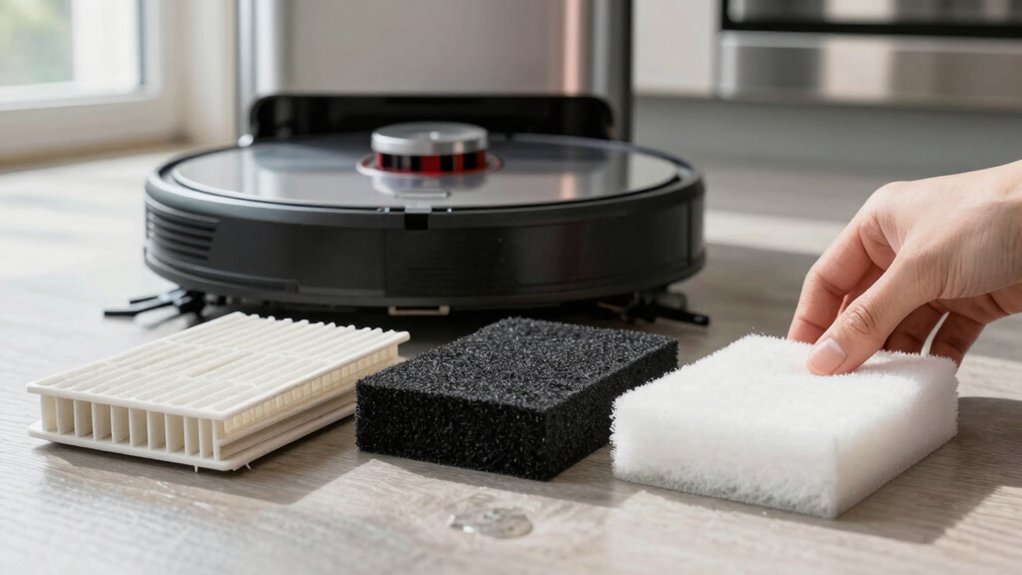
How do the different filter materials actually perform in a robot vacuum? You’ll find distinct trade-offs in filters performance and noise impact: HEPA captures 99.97% of 0.3 µm particles, ideal for allergies, but it can slightly raise airflow resistance and fan noise if clogged. Activated carbon adsorbs odors and gases; therefore, you’ll get better smell control when it’s paired with HEPA.
Foam acts as a washable pre-filter trapping larger debris. This protects inner filters and reduces clogging, which lowers sustained noise by preserving airflow. Cloth is inexpensive and handles big particles; it is common in budget models or as secondary stages.
| Filter Type | Strength |
|---|---|
| HEPA | Particle capture to 0.3 µm |
| Activated Carbon | Odor and gas adsorption |
| Foam | Washable pre-filter, protects HEPA |
| Cloth | Affordable, captures large debris |
| HEPA+Carbon combo | Best overall air quality and odor control |
Choose HEPA plus carbon for air quality. Use foam or cloth for low maintenance and consistent noise impact.
Robot Vacuum Filter Compatibility, Form Factor & Airflow
After picking the right filter materials, you’ll need to make sure the filter actually fits and won’t choke the airflow in your robot. Check your model’s official compatibility list to avoid compatibility dramas. Many manufacturers specify exact part numbers because even small dimensional differences prevent a good seal.
Consider form factor: HEPA cartridges, carbon pads, foam pre-filters, and cloth layers come in distinct shapes and thicknesses. A mismatch can cause bypass leaks or compression that impedes suction.
Airflow matters technically. Wrong-sized or clogged filters raise pressure drop, increase motor load, and reduce cleaning effectiveness. Multi-stage systems combine a pre-filter (foam or cloth) with a dense main filter to balance particle capture and airflow; follow the manufacturer’s stacking order.
Before buying third-party filters, verify dimensions, sealing method, and recommended airflow rating. That prevents form factor pitfalls and preserves suction, motor health, and predictable filtration performance.
Maintenance & Lifespan: Washable vs Disposable Filters
Which filter type will give you the best balance of cost, cleanliness, and longevity? You’ll weigh washable versus disposable by maintenance frequency and lifespan. Washable filters (foam or specific cloth) let you reuse parts after proper cleaning, reducing waste and replacement tasks. Clean them monthly to preserve suction and prevent buildup. Enforce strict drying procedures so you don’t introduce moisture into the system; full drying is essential for mold prevention and to avoid motor corrosion.
Disposable filters need scheduled replacement—typically every 3–6 months depending on use and health needs—because performance drops as they clog or degrade. Clogged or damaged filters reduce airflow and increase motor strain, so monitor pressure and runtime.
Adopt a maintenance plan: monthly cleaning and drying for washable elements, plus timely replacement of disposables where used. That combined approach extends vacuum life, maintains filtration effectiveness, and minimizes risks associated with mold and impaired airflow.
Cost vs Performance: Price, Availability & Long‑Term Value
Now that you’ve set a maintenance routine, weigh the upfront and ongoing costs of replacement parts against their real-world performance. You’ll see official filters and bags cost more but use higher-grade media, giving consistent filtration, lower leakage risk, and better long-term value by preserving suction and air quality.
Third-party options can be five to six times cheaper; however, fog-evaluation failures show many leak, increasing contamination and potential wear.
| Option | Typical outcome |
|---|---|
| Official | Near-perfect containment, predictable performance |
| Third-party | Wide variance; many fail fog tests |
| Some aftermarket | Occasionally matches official, quality not guaranteed |
When considering cost vs performance, include replacement frequency (3–6 months typical) and availability. If you value reliability and measurable containment, official parts are the safer economic choice over time. If budget constraints dominate, test third-party parts cautiously and factor possible increased replacement or maintenance costs into your total ownership math.
Quick Decision Guide: Best Filter by Common Household Scenarios
Wondering which filter fits your home best? For pet hair and dander in a small home, choose a HEPA filter: it traps 99.97% of particles down to 0.3 microns and cuts airborne allergens effectively. If odors from pets, smoke, or cooking dominate, pick a HEPA filter combined with an activated carbon layer to remove both particles and smells.
On a tight budget or for allergy management without high recurring costs, use washable foam or cloth pre-filters paired with a main filter to maintain suction while reducing replacement expenses; this balances price vs durability. Always check model-specific compatibility and favor official replacement filters to ensure optimal performance and avoid fit issues that raise noise impact or reduce suction.
Maintain filters by cleaning washable units regularly and replacing disposables every 3–6 months. That preserves filtration efficiency, keeps your vacuum quiet, and extends the robot’s operational life.
Frequently Asked Questions
How Often Should I Replace Filters for Mold Prevention?
You should replace filters every 3 months for mold prevention, or sooner if you notice reduced dust performance or visible moisture. Check filters monthly and follow a maintenance schedule: inspect for clogging, dampness, or odor. Replace immediately if any signs appear.
In high-humidity or heavy-use homes, swap filters every 1–2 months and use sealed storage for spares. Regular replacement maintains airflow, filtration efficiency, and lowers mold risk.
Can Aftermarket Filters Void My Vacuum’s Warranty?
Yes, using aftermarket filters can void your vacuum’s warranty if the manufacturer specifies approved parts. You should check your warranty terms and grab discussion ideas from user forums and manufacturer FAQs before swapping parts.
Aftermarket filters may fit and perform well; however, they can cause issues manufacturers won’t cover. If you want warranty protection, stick with OEM filters or get written confirmation that compatible aftermarket filters are allowed.
Do Filter Materials Affect Suction Noise Levels?
Yes, filter material impact can change suction noise. You’ll notice denser HEPA or foam filters raise backpressure, making the motor work harder and often louder.
More porous or pleated filters let air flow easier; thus, suction noise can drop. You should balance filtration efficiency against noise: choose materials rated for your model, check airflow (CFM) specs, and prefer manufacturer-approved filters to avoid performance or warranty issues.
Are There Recycling Options for Used Disposable Filters?
Yes, recycling options for used disposable filters are limited but available. You’ll first check the filter material and manufacturer instructions. Some parts, such as plastic frames and foam, can be separated and recycled through local curbside programs or specialty e-waste or household recycling centers.
HEPA media is often non-recyclable and should go to general waste unless a take-back program exists. You’ll also consider municipal hazardous-waste events or retailer take-back programs for proper disposal.
Can Filters Reduce Static Buildup on Carpets?
Yes, filters can help, but they won’t eliminate carpet static. You’ll reduce carpet static modestly by using filters that control fine particulates and retain dust that would otherwise charge fibers.
For two word discussion ideas, try “ion neutralization” and “material conductivity.” You’ll get better results combining a high-efficiency filter with humidity control and anti-static cleaners.
Don’t expect filters alone to solve static; they’re one technical, consumer-focused part of the solution.
Conclusion
Choose the filter that matches your main problem: HEPA for allergy control and fine dust, activated carbon for odors and VOCs, foam or cloth for large debris and easy rinsing.
Check compatibility, airflow impact, and whether the filter is washable or disposable to plan maintenance and replacement costs. Balance upfront price with availability and long-term value.
Match filter type to your household—pets, allergies, odors, or low-maintenance—and you’ll get the best cleaning performance from your robot vacuum.
You may also like: Roomba Filter Replacement Packs For — a related guide worth bookmarking.