Backpack vs Upright Vacuum for Commercial Cleaning: Which Wins on Speed?
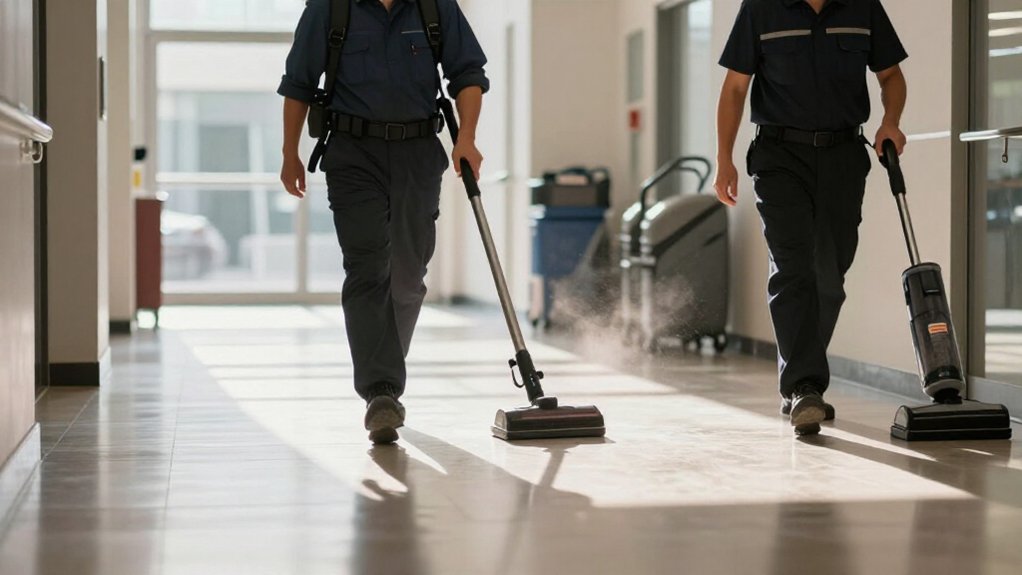
For most commercial cleaning routes, you’ll finish faster with a backpack vacuum.
Reported productivity reaches 7,000, 8,000 square feet per hour, versus 3,000, 4,000 for traditional uprights, especially around desks, stairs, chair legs, and clutter.
Backpacks also reduce repositioning and brush-roll maintenance, while cordless models eliminate outlet delays.
Choose an upright for large, open carpeted areas where powered agitation helps.
Compare noise, HEPA filtration, bag capacity, harness fit, floor type, and service support.
Details below help choose.
Noise, Reach, Cord Handling
If you clean occupied offices, libraries, or hospitals, a backpack vacuum usually offers the quieter working profile: commercial models typically produce 60–75 dB, while newer battery-powered HEPA units often run near 63 dB. That advantage lets you work during occupied hours, although some powerful backpacks can reach 70–75 dB. Your operator hears the motor more directly, so use padding and rotate long routes when exposure rises.
| Equipment | Best use |
|---|---|
| Backpack | Reach stairs, aisles, corners, and under furniture |
| Upright | Simple open-floor passes; handle and cord limit access |
| Wide-area | Fast open-floor coverage; poor in clutter |
You’ll avoid cord snags by carrying the backpack’s power cable over one shoulder, securing slack, and planning outlets; cordless units remove that constraint entirely. An upright still requires repeated plug changes and dragging, slowing transitions between rooms.
Airflow and Filtration Design
Because backpack vacuums deliver suction through a hose and wand at the cleaning head, they maintain airflow while you move around stairs, furniture, and other obstacles. You’ll keep the pickup interface close to the surface, reducing interruptions from repositioning the canister.
Many commercial models add multistage filtration, with certified HEPA options that capture fine particulate reliably and support indoor air quality. Verify the filter’s certification and replacement schedule.
An upright pairs suction with a brushroll, which can improve carpet extraction, but its filtration depends on the filter type and seals in the airflow path. Compare airflow, nozzle design, and filtration claims.
In occupied spaces, a backpack such as the Sanitaire TRANSPORT QuietClean, rated at 70 dBA or less, can combine commercial filtration with quieter operation.
Cleaning Rate per Hour
Measuring cleaning rate by completed floor area, not motor speed, shows why backpacks often outperform uprights in commercial settings. When you track square feet completed per hour, you capture pauses, turns, and repositioning, not just theoretical suction. In commercial routes, a backpack lets you maintain forward motion through desks, chair legs, aisles, and other obstructions. That workflow can produce rates up to four or five times those of typical uprights in maneuverability-intensive spaces.
Use those figures as benchmarks, not guarantees. Reported backpack productivity reaches 7,000–8,000 square feet per hour, while traditional uprights commonly deliver about 3,000–4,000. Your actual rate depends on floor layout, soil load, attachment technique, training, and whether you must detail edges separately. Measure both square feet per labor hour and completed rooms per shift.
Harness Fit and Weight Distribution
Cleaning-rate gains depend on how well the operator can carry and control the machine, making harness fit a key productivity variable. A adjusted backpack keeps the load close to your body, supporting balance and an upright posture while reducing arm-and-wrist strain versus an upright’s push-pull motion.
- Set padded shoulder straps evenly, then tighten the hip belt so your pelvis carries load.
- Secure the sternum strap to limit shifting when you extend the wand furniture and equipment.
- Check fit during a work trial; excessive shoulder pressure or movement signals adjustment, not faster cleaning.
Advanced designs can improve comfort: Tornado’s Pac-Vac Aircomfort system reportedly reduces sweating by up to 25% versus closed-back designs.
With stable weight distribution, you’ll sustain movement longer and reduce fatigue across shifts.
Stairwell and Elevator Access
Stairwells and elevator lobbies favor backpack vacuums because the operator can carry the motor unit while maintaining continuous movement. You can climb each flight and maneuver around railings and tight landings without pushing or repositioning an upright. The resulting reduction in stop-start handling matters on repeated routes, where access time can dominate actual vacuuming.
Use the hose and wand to clean corners, edges, and baseboards while leaving the main body clear of narrow elevator lobbies. Corded models deliver uninterrupted runtime across full stairwell and elevator runs; cordless models remove outlet constraints in bays and stair towers.
Commercial claims sometimes report backpacks working up to four or five times faster than typical uprights in these settings, though results depend on design, operator technique, and training.
Bag Capacity and Replacement Frequency
Capacity is a throughput variable: a commercial backpack’s larger collection volume can reduce emptying trips and keep you moving longer between service stops. On a commercial route, that reserve cuts emptying-related travel and protects your square-foot-per-hour target.
You’ll manage capacity through planned checks rather than complex repairs. Use traffic and debris data to set replacement intervals:
- High traffic: Check bags or containers each shift; dense debris fills capacity faster.
- Moderate traffic: Inspect at route milestones and replace consumables when pickup declines.
- Low traffic: Extend checks, but follow storage and manufacturer limits.
Backpack bags or containers can be reloaded faster than upright canisters, helping you resume production. Track replacements by hours, site, debris; forecast inventory and schedule swaps before capacity limits production.
Dust During Bag Changes
When you change bags, a sealed commercial backpack system typically releases less dust than a comparable upright because its bag chamber and filtration path are designed to contain debris during removal.
A HEPA-equipped model can trap fine particulate through the final filter stage, reducing exposure as you disconnect and replace the bag. Commercial backpacks also commonly provide faster access, so you keep the chamber open for less time.
Their body-mounted design lets you service the unit with less repositioning near the floor, which helps prevent disturbed dust clouds in occupied corridors. By contrast, an upright’s dirt path and bag housing may retain residual fines around the canister, allowing more dust to escape during removal. To control risk, seal the used bag promptly and properly.
Brush Roll Maintenance Differences
You’ll typically access, clean, and replace an upright’s rotating brush roll and belt, while a backpack floor tool usually has fewer brush-drive components. Check uprights for hair and soil buildup because restricted rotation reduces agitation, increases belt strain, and can lower pickup efficiency.
With backpacks, you’ll generally spend maintenance time on filters and airflow paths instead of brush-roll service, reducing mechanical downtime.
Brush Roll Access
During routine service, upright vacuums typically require direct access to a powered brush roll, belt, and brush strips. You’ll reach the brush head to clear wrapped debris and preserve carpet agitation. Backpack vacuums generally use suction through a floor tool or wand, so you’ll encounter fewer brush-driven components and less access demand.
Compare access points on your route:
- Upright heads concentrate debris, making brush-roll inspection a checkpoint.
- Belt-driven designs add another component you must reach when rotation weakens.
- Backpack tools shift attention to the nozzle, hose, and airflow path rather than brush-roll access.
That difference can shorten service interruptions with a backpack, especially across routes. Still, you should verify each model’s tool design: some attachments include agitation, while others rely almost entirely on suction.
Cleaning And Replacement
Brush-roll access also affects how often each vacuum needs cleaning and replacement. If you run an upright on commercial carpet, inspect its powered brush roll regularly for wrapped hair, packed debris, bristle wear, and belt damage. Replace worn brushes or belts when agitation and pickup decline; otherwise, downtime and repeat passes can erase speed gains.
Your backpack vacuum typically uses suction through a wand or floor tool, often without a beater brush. That design removes recurring brush-roll and belt servicing, leaving you to check hoses, seals, and filters.
You’ll usually clean or replace filters according to loading and manufacturer intervals, then swap other consumables as needed. In high-traffic facilities, these simpler tasks can shorten shift-change maintenance and improve availability. Match equipment to carpet demands.
Sealed Floors vs. Carpets
On sealed floors, you’ll typically move faster with a backpack vacuum because its wand reaches around obstacles and under fixtures with fewer repositioning steps. On carpets, an upright’s motorized brush roll usually removes embedded soil more effectively than a standard backpack nozzle.
For mixed surfaces, use the backpack for continuous hard-floor coverage and reserve the upright for carpeted sections.
Hard Floor Maneuverability
For sealed tile, vinyl, laminate, and polished concrete, a backpack vacuum gives you better maneuverability because its wand and floor tool reach under desks, around chair legs, and along baseboards without dragging a bulky body across floor junctions.
Backpack use also preserves speed in tight aisles because you push and pull less mass through frequent turns. Uprights can win on long straight runs with few obstacles but force more repositioning when furniture interrupts access.
To choose effectively, consider these factors:
- Match floor-tool width to aisle clearance, allowing continuous passes around fixed obstacles.
- Select sealed-filtration or HEPA-capable models to limit dust re-release during pickup.
- Fit hip and sternum straps correctly; poor adjustment reduces mobility and increases fatigue. Train operators to sweep consistently.
Carpet Deep Cleaning
Hard-floor maneuverability favors a backpack, but carpet deep cleaning often favors an upright. Its powered rotating brushroll agitates fibers and lifts ground-in soil more effectively than most backpack tools. Backpack systems prioritize nozzle suction, so results depend on wand design.
If you need maximum embedded-debris removal, choose an upright and schedule deliberate passes rather than relying on speed alone. Inspect the brushroll, belt, and filter regularly; worn components reduce pickup and increase repeat passes.
That maintenance protects consistent extraction performance.
On sealed tile or VCT, you’ll keep moving with a backpack, using wand tools for edges and furniture contact. In mixed facilities, it maintains progress around obstacles, but ground-in carpet warrants an upright pass. Choose based on whether deep extraction or route speed matters.
Surface-Specific Performance
Surface type largely determines which vacuum delivers the higher cleaning rate.
- Sealed floors: You’ll usually move faster with a backpack. Its hose and wand let you maintain forward motion around fixtures, aisles, and tight edges without repositioning a bulky upright. Use a floor nozzle that maintains strong contact and suction.
- Carpets: You’ll generally get deeper, faster soil removal per pass with an upright. Its motorized brushroll agitates fibers and lifts embedded debris more effectively than most backpack heads. That advantage matters during restorative or high-traffic cleaning.
- Mixed surfaces: A backpack can improve route productivity when you switch tools at the point of contact. In obstacle-dense areas, navigation gains may offset weaker carpet agitation. For carpet-heavy routes, select an upright; for sealed-floor-heavy routes, choose the backpack.
Warranty Response Times
When a vacuum fails, a backpack system may return to service faster because major suppliers often offer next-day or rapid-turnaround support for high-use commercial equipment. Suppliers may stock backpack filters and attachments, while upright support prioritizes belts and brush parts. However, warranty coverage usually targets motors and major defects, not wearable filters, hoses, belts, or brushes.
You shouldn’t assume every failure qualifies for expedited repair.
Before choosing, confirm the service location, stated turnaround, parts availability, and escalation process. Ask whether shipping time counts in the estimate. A covered motor failure may receive rapid handling; a clogged filter or worn belt may require routine maintenance instead. Compare expected downtime against your labor cost per hour. Fastest warranty service wins when coverage matches likely failure points.
Conclusion
When you compare commercial cleaning speed, don’t judge by motor power alone. Measure usable square feet per hour, including cord moves, stair shifts, bag changes, and brush-roll service.
Choose a backpack when you need fast, quiet coverage across carpeted, obstructed spaces and can fit each operator correctly. Choose an upright when sealed hard floors, edge control, filtration, and simpler handling matter more. Track labor minutes and warranty response; your site’s data should make the decision.