HEPA vs Standard Filter Buying Guide: Is the Upgrade Worth It for You?
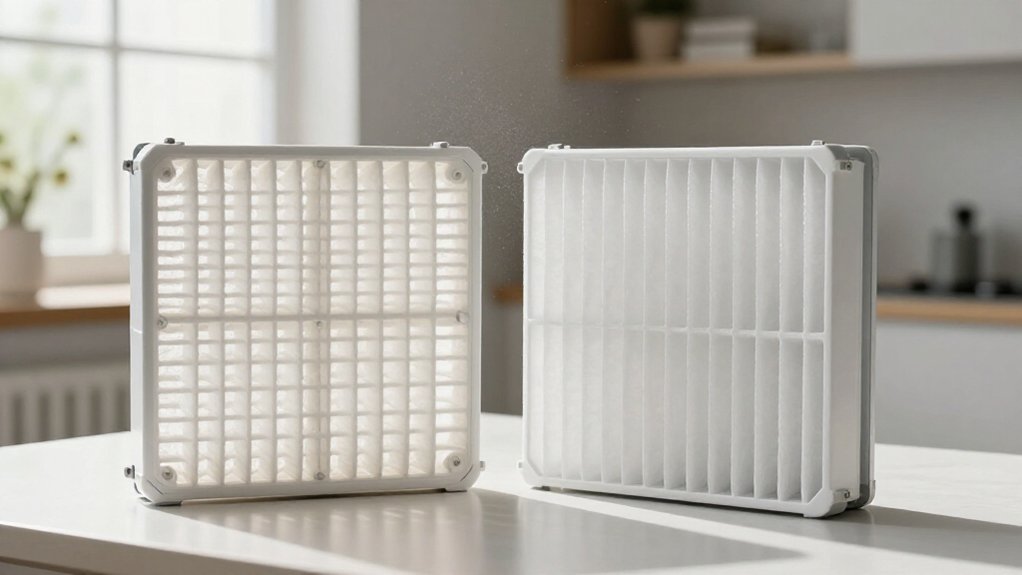
A HEPA filter captures at least 99.97% of particles at 0.3 micrometers, making it stronger for smoke and fine pollen than standard MERV 8, which mainly handles larger dust and lint.
If you upgrade an HVAC system, check blower capacity, static pressure, seals, and filter dimensions first.
For typical homes, MERV 8 may cost less and preserve airflow.
Choose HEPA for fine-particle reduction; compare CADR, energy, replacement costs, and conditions to see if upgrading fits.
HEPA vs. MERV 8
When you’re comparing HEPA with MERV 8, the key difference is fine-particle performance versus HVAC compatibility. HEPA media targets fine particulates and smoke, while MERV 8’s low resistance supports residential airflow. MERV 8 suits pollen, lint, and larger dust but offers limited submicron aerosol removal.
| Option | Best fit |
|---|---|
| HEPA | Fine particles; rooms |
| MERV 8 | Standard HVAC; coarse dust |
If you’re choosing HEPA for HVAC, don’t install it without checking blower capacity, pressure drop, and housing seals. Dense media can reduce airflow and strain equipment. A portable True HEPA purifier avoids HVAC modification, but match its CADR to room size.
Choose MERV 8 when you need affordable drop-in filtration and HVAC protection. Upgrade when fine-particle pollution or sensitive occupants make cleaning a priority in your most occupied room.
HEPA’s 99.97% Capture Rate
A True HEPA filter must capture at least 99.97% of airborne particles measuring 0.3 micrometers—the most penetrating particle size and consequently a demanding performance benchmark.
As air passes through dense, pleated media, interception, impaction, and diffusion work together to retain particles. As a result, you can treat the rating as a defined minimum under specified test conditions, not a guarantee of identical whole-device performance. Check True HEPA labeling, certification, and manufacturer test data before you buy.
“HEPA-like” or “HEPA-style” wording isn’t standardized and may not demonstrate the threshold. A pre-filter can reduce loading, while proper sealing helps prevent bypass around the media. For a meaningful comparison, prioritize independently verified efficiency and confirm that the unit’s airflow remains adequate after filtration for your specific intended home application.
Smoke and Pollen Removal
For smoke and pollen, choose a purifier with verified True HEPA filtration and a CADR appropriately sized for your room. True HEPA captures at least 99.97% of particles down to 0.3 microns, covering key smoke and pollen particles.
During wildfire smoke or heavy pollen, compare performance on both high and low fan speeds; some units filter effectively only at maximum speed.
Choose activated carbon if you need odor reduction, but don’t rely on it to remove gases such as formaldehyde, ammonia, or nitrogen oxides. Avoid ozone-generating purifiers because ozone can irritate airways and reduce lung function.
HEPA removes airborne particles from your breathing air, but it won’t remove pollen settled on surfaces or smoke residue. Vacuuming and cleaning remain necessary. This supports cleaner breathing.
Installation Tools and Steps
Before you install a HEPA-based purifier, verify its certified efficiency, airflow requirements, and replacement-filter specifications. For a portable unit, you’ll need the manual. Place the purifier where its clean-air stream can mix with room air, keep vents unobstructed, and run it long enough to achieve meaningful CADR-driven air turnover.
For whole-house installation, use a screwdriver, gloves, and a pressure gauge if specified by the manufacturer. Have an HVAC professional evaluate fan capacity and static pressure before adding dense HEPA media; excessive resistance can reduce airflow and efficiency.
For DIY dust control, install a cyclone or pleated pre-filter before the HEPA stage. Follow manufacturer instructions, replace mechanical or HEPA filters about every six to twelve months, and carbon stages about every three months for performance.
Check Filter Slot Dimensions
Once you’ve confirmed the purifier’s airflow requirements, measure your HVAC filter slot’s length, width, and thickness. Don’t rely on nominal labels; verify the space and compare it with the manufacturer’s dimensions. A mismatch can leave gaps, allowing unfiltered air to bypass the media and reducing particle removal.
Check whether the housing accepts a denser HEPA-style filter, which may be thicker and less airflow-friendly than a standard pleated filter. Many systems use three- to five-inch media, but you should confirm the thickness before buying. For a whole-house retrofit, verify that the air handler and filter housing support the added static pressure. If you’re choosing a portable purifier, measure the room volume and confirm its CADR meets your cleaning target; physical fit doesn’t establish adequate filtration.
Fan Energy Consumption Impact
Denser HEPA media increases static pressure, so your HVAC system or portable purifier may need more fan power to maintain airflow than it would with a standard filter. That added resistance can raise wattage, especially when you run a portable purifier continuously. Compare energy use at the speeds you’ll actually use, not only the maximum setting used in CADR testing.
Lower settings, including those at or below 50 dB, may clean more quietly but can have different efficiency and operating costs.
Running a purifier 24 hours daily makes modest wattage differences compound. HEPA filters often last 6–12 months, but fan energy depends mainly on airflow restriction. Estimate yearly electricity as watts × hours ÷ 1,000 × utility rate, then compare total with standard-filter costs.
Static Pressure and Compatibility
Fan energy costs often reflect a more basic constraint: the filter’s resistance to airflow. Dense HEPA media creates greater static pressure than standard HVAC filters, so your blower may work harder and deliver less air through the vents. High filtration efficiency per pass doesn’t guarantee effective cleaning if reduced airflow limits circulation.
Before upgrading, check your HVAC manufacturer’s pressure drop, filter dimensions, and blower capacity. A technician can measure static pressure and confirm that the housing and ductwork seal. If your system can’t support true-HEPA resistance, choose a high-MERV filter or a bypass HEPA module rather than forcing the upgrade.
Avoid “HEPA-like” claims: they may not meet HEPA performance requirements. Proper compatibility protects equipment, maintains airflow, and supports healthier indoor air without compromising ventilation.
Annual Filter Replacement Costs
You’ll typically replace mechanical HEPA and standard filters every 6–12 months, but your annual cost depends on each filter’s price and service life.
Compare replacement prices across models, since costs can range from about $20 to more than $200 per filter. Don’t forget that carbon pre-filters, which may require replacement every three months, and continuous electricity use can substantially increase your purifier’s total annual operating cost.
Filter Replacement Frequency
Although replacement schedules vary by model and usage, most mechanical or HEPA-style purifier filters should be changed every 6–12 months, with replacement costs ranging from about $20 to more than $200. Your interval depends on runtime, fan speed, smoke, dust, and pets. Continuous use may load media faster; follow rated hours or months. Inspect monthly; replace sooner if coated, airflow falls, or odors persist. Restricted airflow can reduce clean-air performance, so don’t rely on the calendar alone.
Activated carbon odor filters typically need replacement every three months. A washable pre-filter captures debris and may extend HEPA life; clean it as directed. For allergy or asthma concerns, timely replacement helps preserve effective particle removal. Check fit and sealing after installation to prevent bypass and maintain filtration consistently.
Annual Cost Comparison
Once you’ve set a replacement schedule, compare annual operating costs—not just the purchase price. A true-HEPA purifier typically needs a filter every 6–12 months, while carbon odor media may require replacement about every three months. Consumer Reports’ cost model adds those replacement expenses to electricity for continuous, 24/7 operation, giving you a more realistic yearly total.
Large purifiers can have filter costs ranging from about $20 to more than $200; carbon add-ons may add roughly $50.
Standard pleated filters usually cost less per replacement, but you’ll need to match the MERV rating and schedule to your HVAC system. For whole-home HEPA retrofits, include installation, sealing, pressure-drop, and fan-compatibility considerations, which can increase costs. Don’t equate “HEPA-type” savings with health protection: uncertified performance complicates value comparisons.
Best for Pet Owners
If you’re managing pet dander, choose a certified True HEPA purifier, which captures at least 99.97% of 0.3-micron particles, and vacuum settled hair and dust regularly. For pet odors, select a model with activated carbon, while recognizing that carbon’s gas removal varies and doesn’t replace ventilation.
Prioritize a pet-friendly filter with suitable CADR, low-speed noise, a washable pre-filter, and no ozone generation.
Capturing Pet Dander
Choose a model with sufficient CADR for your room; higher CADR cleans the air faster. Replace the mechanical filter about every 6–12 months, or follow the manufacturer’s loading indicator, because clogged media can reduce airflow and performance.
A purifier addresses particles suspended in air. It won’t remove dander settled on carpets, upholstery, or floors, so vacuum regularly, ideally with filtration. This practical combination reduces exposure, not allergen levels.
Reducing Pet Odors
For pet odors, look for a purifier that combines a true HEPA filter with activated carbon: HEPA captures airborne dander, hair, and dust, while carbon adsorbs many odor-causing gases. Choose a True HEPA model rather than a HEPA-like unit; certified HEPA media captures at least 99.97% of particles down to 0.3 micrometers, helping reduce fine pet-related particles that can keep odors circulating.
Size the purifier for your room and check its CADR; higher CADR delivers more clean air per minute, whereas an undersized unit may leave odor-laden air partially treated. Carbon may perform poorly against some gases, including formaldehyde, ammonia, and nitrogen oxides, so identify the source if stale or smoky smells persist. Don’t use ozone generators: ozone can irritate throat and inflame lungs.
Choosing Pet-Friendly Filters
Beyond odor control, a pet-friendly purifier should use true HEPA media rated to remove at least 99.97% of particles at 0.3 µm, capturing fine dander and dust that standard HVAC filters may miss. Choose “True HEPA,” not “HEPA-like,” because the latter lacks a consistent performance standard.
- Select a unit with CADR and room-size ratings that match your space.
- Add activated carbon for odors, but don’t expect reliable removal of formaldehyde, ammonia, or nitrogen oxides.
- Run the purifier consistently, even 24/7; HEPA can’t capture allergens settled on carpets or furniture.
- Replace mechanical filters every 6–12 months and carbon filters about every three months.
A pre-filter traps fur, extending HEPA life. Vacuum and clean surfaces regularly, since airborne filtration complements—not replaces—source control.
Consider Household Humidity Levels
Maintaining indoor relative humidity at about 30–50% can help limit mold growth and dust-mite conditions while reducing irritation from overly dry air. If your home stays above roughly 50–60% relative humidity, moisture can support mold and dust mites, potentially increasing airborne biological particles. A HEPA purifier may then provide more value, but it won’t correct the underlying moisture problem. Use a hygrometer to measure each room rather than guess, and use a dehumidifier when readings remain high.
During heating season, indoor RH can fall below 30%, drying nasal passages and making irritants feel harsher even when particle levels are controlled. Set a humidifier or dehumidifier based on measurements, and control indoor moisture promptly. This can reduce filter loading by limiting moisture-driven mold contamination indoors.
Conclusion
Choosing a HEPA filter over MERV 8 can meaningfully improve particle removal, especially if you manage smoke, pollen, or pet dander. However, you shouldn’t assume higher efficiency is automatically better. Measure your filter slot, confirm your system can handle HEPA’s static pressure, and budget for annual replacements.
Consider humidity, too, because moisture can promote microbial growth. If compatibility and cost fit your household, the upgrade offers meaningful respiratory protection; otherwise, a properly fitted standard filter remains a practical choice.