Robot Vacuum Vs Robot Vacuum and Mop Differences
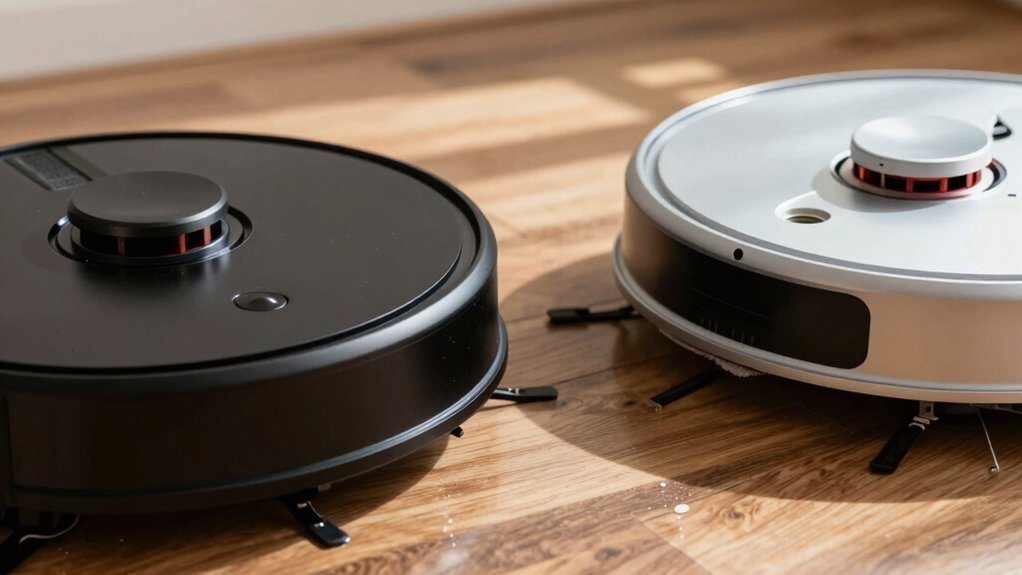
You’ll pick a vacuum-only robot when carpet suction, longer run time, and simpler upkeep matter most. It uses stronger suction and brushes to lift hair and debris without wetting fibers.
A vacuum + mop hybrid adds water, pads or rollers, and scrub action to tackle sticky spills and finish hard floors. However, it needs more maintenance and careful carpet protection.
Choose based on floor mix and chores, and keep going to learn specific tradeoffs and features.
Quick Overview
- Vacuum-only models focus on stronger suction and brush systems for superior carpet and dry debris pickup.
- Vacuum+mop hybrids add water and mop pads or rollers to remove sticky residues from hard floors.
- Hybrids can wet carpets unless mop-lift or carpet-detection features reliably stow the mop.
- Vacuum-only units usually require less maintenance and have simpler docks than self-cleaning hybrids.
- Choose vacuum-only for carpet-heavy homes. Choose hybrid for mixed hard-floor homes needing regular mopping.
Quick Answer: Who Should Buy a Vacuum vs. a Vacuum + Mop
Wondering which robot cleaner fits your home best? You’ll choose based on floors and chores: if carpet care is your priority, go with a vacuum-only model. It delivers stronger suction, longer run times, and simpler upkeep. This is ideal for homes dominated by rugs where pickup matters more than mopping.
If hard floors and frequent spills are common, pick a vacuum + mop hybrid. That dual-function design handles dry debris and wet messes, reducing how often you pull out a separate mop and improving spill handling on tiles and laminate.
Hybrids like the Narwal Freo Z Ultra add self-cleaning and self-emptying conveniences; however, expect higher cost and maintenance. Vacuum-only units (think 3i S10 Ultra-class performance) tend to offer top hard-floor suction numbers and easier maintenance. Therefore, they’re better when battery life and power matter more than wet-clean capability.
Choose vacuum + mop for integrated wet cleaning and time savings. Choose vacuum-only for suction-focused, low-maintenance carpet care.
How They Clean: Suction, Brushes, Rollers, and Mop Systems
Think of robot cleaners as two complementary toolkits: vacuums use suction plus rotating brushes or rollers to lift dry debris, with suction ranging roughly from 2,000 Pa to over 16,000 Pa on high-end models. Mops deploy water and microfiber or roller mop pads to scrub hard floors. You’ll judge vacuums by brush mechanics and suction power: side brushes sweep edges; main rollers (bristle or rubber) agitate and channel dirt to the intake, and higher Pa numbers mean better pickup on stubborn particles.
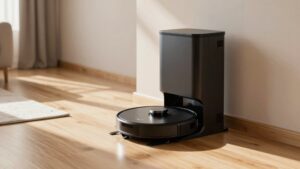
Mops rely on pad type and water delivery—microfiber for light soil; roller mop systems for heavier scrubbing and wider coverage. Hybrid units combine both, adding features like auto-mop lift and mop-pad drying at docks so the mop doesn’t wet carpets. High-end models add auto-empty docks and self-cleaning mop routines, reducing upkeep. Know that brush design, suction power, and mop mechanism determine performance. Therefore, pick the toolkit that matches your floor care needs.
Which Floors Each Type Handles Best (Carpet, Low/High Pile, Hard Floors)
Which floors suit each robot type depends on whether you need suction-driven pickup or wet scrubbing: robot vacuums excel on carpets, especially low-pile and many mid-pile rugs, because strong suction and effective roller/brush designs lift embedded debris. Mopping hybrids shine on hard floors where microfiber or roller pads remove sticky residues and polish edges.
You’ll prefer a pure robot vacuum if carpet dominates. Top models deliver near-complete pickup on hard floors too, and they avoid wetting fibers. For mixed homes, hybrids work best when hard floors need regular mopping and vacuums handle rugs. Look for carpet first routing or mop lift features to prevent moisture on rugs.
Low-pile carpets are broadly well-managed by both types; however, high-pile needs dedicated suction and brushes. For tight spots and baseboards, models with precise navigation and extendable mops improve edge cleaning and corner reach on hard surfaces. Vacuums still outperform on deep-fiber extraction.
Real Tradeoffs: Water Use, Stains, Carpet Safety, and Pets
How do water capacity, mop design, and carpet-safety features change what you’ll actually get from a robot vacuum-mop versus a dedicated robot vacuum? You’ll trade simplicity for versatility. High water use systems like the Narwal Freo Z Ultra and ECOVACS X8 Pro OMNI (4.6 L) let you run longer mopping cycles and self-cleaning, reducing refills. Smaller tanks limit runtime and performance on larger homes.
Mop design drives stain results: roller/mop systems (Dreame X50 Ultra, 3i S10 Ultra) remove stubborn marks better than fixed pads. Extended pads (Saros 10R) reach edges and corners that others (S1 Pro) miss. Carpet-safety matters; models that lift or stow pads prevent wetting rugs. Others that leave pads at the base can risk damp carpets.
For pet owners, pet performance splits. Some units (Saros 10R, X50 Ultra) avoid tangles, while Narwal showed hair-clump issues behind rollers. You should prioritize anti-tangle designs and effective hair management.
Maintenance Reality: Filters, Mop Pads, Dirty‑Water Care, and Auto‑Emptying
You’ve seen how water use, mop style, and carpet-safety shape real-world performance. Now look at what upkeep will demand from you. The maintenance reality centers on filters, mop pads, dirty-water care, and how well auto-empty actually clears debris.
Auto-empty performance varies: Narwal Freo Z Ultra hit 0 g remaining in tests, while others like eufy S1 Pro left measurable residue (about 2.5 g). Some models accumulate several grams in fine filters after repeated cycles. That means you’ll check fine filters regularly; larger suction systems clog faster.
Mop pads and systems differ: roller mops need more hands-on dirty-water filter cleaning (expect 5–10 minutes monthly per unit), while spinning-pad designs require only about 30 seconds. Water-tank size also affects chores; bigger reservoirs (ECOVACS X8 Pro OMNI at 4.6 L) mean fewer refills than smaller ones (eufy S1 Pro at 3 L).
Choose a design whose maintenance cadence fits your tolerance and schedule.
Smart Features That Matter: Object Avoidance, Mop Lift, and App Control
When choosing a robot that’ll actually navigate your home without constant babysitting, focus on object-avoidance accuracy, reliable mop-lift mechanics, and transparent app control. These features determine whether the bot dodges toys and pet messes, protects carpets, and lets you tweak behavior in real time.
You’ll prefer models like the Dreame X50 Ultra that label detected objects with distances in the app, giving clear feedback on object avoidance. In contrast, steer clear of the Narwal Freo Z Ultra, which struggled with obstacles and dog waste. Mop-lift behavior separates winners and losers: DEEBOT X9 PRO OMNI and some others reliably raise pads over carpet; whereas units such as the 3i S10 Ultra can jam or leave pads down.
App control is the tie-breaker. Good apps show obstacles and distances, let you edit maps, and adjust routes on the fly. That transparency turns object-avoidance claims into verifiable performance you can monitor and tweak.
Price vs. Performance: When to Splurge and Model Examples
Wondering whether the extra cost of premium robot vacuums and hybrids actually pays off? You’ll weigh price vs. performance by matching needs: if convenience and low-touch upkeep matter, splurging on hybrids like the Narwal Freo Z Ultra (MSRP $1499, sale ~$1099) makes sense. It self-empties up to 120 days and left 0 g after auto-empty.
ECOVACS X8 Pro OMNI ($1299) targets frequent auto-emptying (~30 minutes) and leads carpet pickup (75.5%); this shows hybrids can favor suction or mopping depending on design. If hard-floor cleaning is your priority, the 3i S10 Ultra and Dreame X50 Ultra deliver top debris pickup and spinning-pad performance respectively.
For edge cleaning, Roborock Saros 10R’s extended mop pads outperform the non-extendable S1 Pro. Note maintenance tradeoffs: better convenience often trades off vacuum power. Narwal’s lower carpet pickup is ~36.75%. Choose based on whether reduced chores or stronger suction matters more to you.
Final Buying Checklist: Questions to Answer Before You Buy
How will this robot actually fit into your life? Ask if you need mopping: do you want integrated wet cleaning plus suction, or will vacuum-only dry pickup suffice with longer runtimes?
Compare mop capabilities: does the model use an OZMO roller with auto-wash and auto-mop lift like the DEEBOT X9 PRO OMNI, or a simple pad, or none at all? Consider edge and corner performance: some combos (Roborock Saros 10R, ECOVACS X8 Pro OMNI) extend pads for better edging; others do not.
Weigh maintenance: will you handle water tanks, replaceable pads and extra upkeep, or prefer fewer consumables? Factor cost versus value: are premium $1,299–$1,899 features worth it for self-empty/self-clean routines, or is a cheaper vacuum-only model smarter?
Use two-word discussion ideas to quickly compare options. If a feature truly does not affect your home, mark it subtopic not relevant and move on: buy what matches daily needs, not bells.
Frequently Asked Questions
Do Robot Vacuums Work Well on Pet Hair Between Deep Cleanings?
Yes, a robot vacuum can handle pet hair between deep cleanings. You’ll find robot vacuum models that pick up surface pet hair efficiently, especially on hard floors and low-pile carpets.
They won’t replace periodic deep cleans; embedded fur and dander accumulate, but they reduce daily buildup. Choose a model with strong suction, a brush roll designed for hair, and a high-capacity bin to keep maintenance manageable.
Can Vacuum‑And‑Mop Systems Damage Wood or Laminate Finishes?
They can, but usually won’t if you pick the right model and settings. You’ll avoid water damage by using minimal-moisture modes, scheduled damp mops, or disposable pads designed for wood finishes.
Compare units by water control, pad pressure, and cleaning patterns: that two word discussion ideas: “moisture control.” If you leave excess water, use abrasive pads, or run frequent high-pressure cycles, you’ll risk swelling, warping, or finish wear.
How Noisy Are Robot Vacuums During Scheduled Overnight Runs?
You’ll usually hear a low hum rather than loud clatter during overnight scheduling. Most models keep dust noise minimal. Quieter, premium robots run around 50–60 dB; budget units can hit 65–70 dB, which wakes light sleepers.
You’ll want models with “quiet” or “eco” modes and soft-bristle brushes to reduce rasping dust noise. Compare specs and user reviews to pick a machine that won’t disturb your sleep.
Are Replacement Mop Pads and Filters Easy to Find and Affordable?
Yes, replacement mop pads and filters are generally easy to find and affordable. You’ll source replacement accessories from brand sites, online marketplaces, or third-party sellers. Prices vary by model; however, most replacement parts stay inexpensive.
Compare genuine vs compatible replacement parts for durability and cost. Genuine filters and pads usually cost more but last longer. You’ll save by buying multipacks or trusted third-party replacements when compatible.
Do These Robots Detect and Avoid Stairs and Small Drops?
Yes, most models use cliff sensors for stair detection and drop prevention, so you won’t see them tumble. You’ll find many robot vacuums and vacuum-and-mop hybrids employ infrared or lidar sensors and bumpers to map edges and avoid falls.
Higher-end units combine cameras and SLAM mapping for smarter avoidance and quicker recovery. Still, sensor quality varies; so compare models and read reviews to ensure reliable edge detection for your layout.
Conclusion
If you mainly have carpet, pets that shed, or want the strongest suction, stick with a robot vacuum. It’s simpler, lighter on maintenance, and better at deep-cleaning fibers.
If you have mostly hard floors, occasional sticky messes, or want fewer mopping chores, choose a vacuum + mop for combined sweeping and damp cleaning. Consider mop-lift, water control, and carpet safety features. Match features to floors, pet needs, and how much upkeep you’ll tolerate.
You may also like: To Choose Replacement Roller Brushes — a related guide worth bookmarking.