Lidar Vs Camera Robot Vacuum Navigation
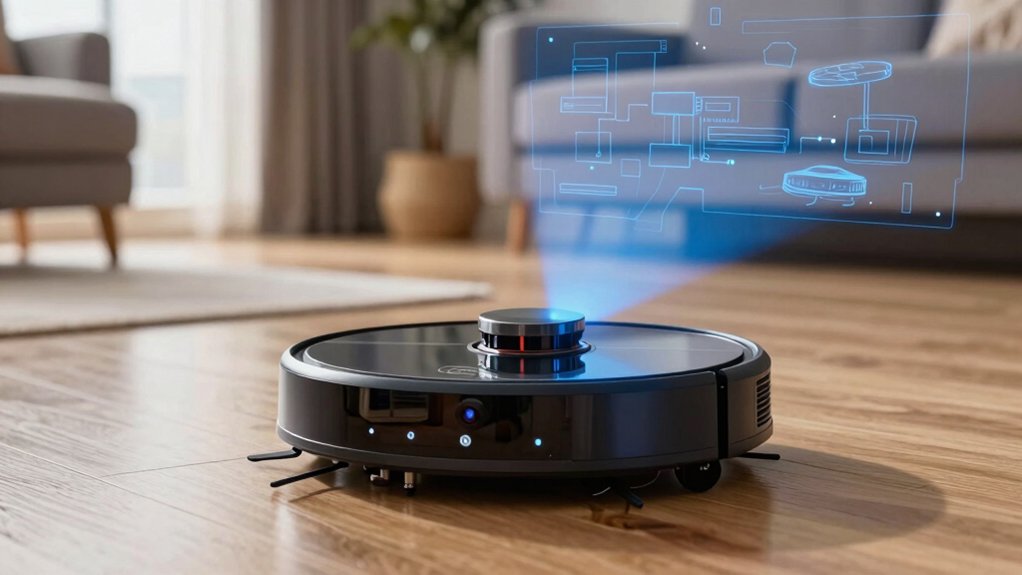
You should pick LiDAR when you need lighting-independent, millimeter-accurate maps and rock-solid obstacle detection. It gives true metric depth and excels in dark rooms, pet-filled homes, and tight corners.
Choose camera (vSLAM) if you want lower cost and richer visual context; it’s a well-lit, textured home. Its depth is inferred and degrades in low light.
Hybrid systems fuse both for balance, and the sections that follow explain how each performs and why.
Quick Overview
- LiDAR uses laser pulses to produce metric 3D point clouds, giving precise, lighting-independent distance measurements.
- Camera (vSLAM) tracks visual features to estimate motion and scene structure; however, depth is relative and lighting-dependent.
- LiDAR excels in dim rooms, around pets, and tight corners. It maintains high mapping accuracy and reliable obstacle detection.
- Camera systems are cheaper and add semantic detail (e.g., object recognition) in well-lit, textured environments.
- Hybrid systems fuse LiDAR’s metric geometry with camera semantics for robust navigation. They also provide privacy control and better obstacle classification.
LiDAR vs vSLAM: Quick Recommendation
Wondering which system suits your home better? You’ll choose LiDAR if you need mapping precision and consistent performance in low light or cluttered rooms. LiDAR gives millimeter-level distance accuracy and faster, more reliable obstacle detection. You’ll get quicker, repeatable maps and fewer navigation errors; this is important if you have complex layouts or frequent furniture changes.
Choose vSLAM if you prioritize compact pricing and richer visual context for open, well-lit spaces. It’s effective where textures and light aid localization and typically costs less. If you value quiet, predictable cleaning, LiDAR models often pair well with silent operation and robust sensing. For budget-conscious buyers in simple floorplans, vSLAM delivers adequate coverage with lower upfront cost.
If you want both accuracy and visual detail, consider hybrid systems that blend LiDAR’s precision with camera-based context. Match the sensor to your environment and budget: LiDAR for precision and lighting independence, vSLAM for affordability and visual richness.
What LiDAR and vSLAM Actually Measure
What do these sensors actually measure, and how does that shape the maps your robot builds? LiDAR measures precise distances by emitting laser pulses and timing returns; it produces 3D geometry as dense point clouds. That direct depth sensing yields millimeter-level range data you can use for metrically accurate layouts and obstacle geometry.
vSLAM, by contrast, measures image-frame motion through feature tracking. It follows visual landmarks across frames to estimate camera pose and infer scene structure indirectly. You’ll get textured maps with rich visual context, but depth that’s relative to pose estimates and dependent on lighting and scene texture. Because vSLAM derives depth from parallax and tracked features, its metric scale is weaker unless supplemented by depth sensors or loop closures.
In short, LiDAR gives you robust, absolute geometric measurements; vSLAM gives you camera-relative structure and semantic richness driven by how well features can be tracked.
Mapping Accuracy, Obstacle Detection & Lighting Differences
How accurately your robot maps a room and detects obstacles depends on the sensor mix: LiDAR gives millimeter-level range readings that produce metrically precise, lighting-independent 3D geometry. Camera-based vSLAM supplies rich visual context but yields less precise, camera-relative depth that deteriorates in low light or on texture-poor surfaces. You’ll see LiDAR deliver superior mapping precision and lighting resilience; it supports fast 3D mapping and reliable obstacle segmentation regardless of illumination.
Cameras add semantic detail and improve obstacle classification when feature visibility is high. However, depth perception and convergence suffer in dim or uniform environments. Hybrid systems use data fusion to combine metric distance with visual context, raising environmental robustness and segmentation quality across scenarios. Choose based on priorities: pure LiDAR for consistent precision and straight-line planning; camera-vSLAM for contextual cues in textured spaces; fused setups for balanced depth perception and semantic awareness.
| Sensor | Strength |
|---|---|
| LiDAR | mapping precision |
| Camera | feature visibility |
Real‑World Winners: Pets, Dark Rooms, and Tight Corners
Ever tried letting a robot loose around a sleeping pet or in a pitch-dark hallway? You’ll see LiDAR win in real world scenarios: it keeps mapping accuracy above 95% in dim conditions, so it detects edges and establishes No-Go zones reliably.
Cameras can drop roughly 40% in accuracy as light falls; they’re less trustworthy near skittish pets or in unlit corners. In tight corners, LiDAR’s precise edge detection reduces collisions. Visual SLAM performs well in bright, textured rooms but degrades as lighting worsens.
Hybrid systems offer a pragmatic balance, using non-visual sensing to protect privacy while maintaining performance in the dark. For deployment decisions, weigh two word discussion ideas like privacy concerns and sensor fusion separately from cost or battery topics.
In short, if your home includes sleeping animals, dark hallways, or narrow passages, LiDAR or a LiDAR-centric hybrid will typically give you the most consistent, predictable navigation results.
Cost, Battery Life, and Maintenance Differences
Curious which navigation tech hits your budget and upkeep sweet spot? You’ll weigh cost considerations first: LiDAR models cost more up front but often deliver longer-term value through precise mapping and fewer false positives. Camera-based systems are more budget-friendly initially. Mixed-sensor units sit between, raising initial price and maintenance complexity but reducing map recalibration frequency.
Battery tradeoffs are subtle. Real-world runtimes can be similar, though continuous LiDAR scanning draws a bit more power. Some dual-modality designs actively manage sensors to preserve runtime. Expect marginal runtime differences rather than dramatic gaps.
Maintenance differs by sensor type. LiDAR needs occasional alignment checks and dust protection. Cameras demand lens cleaning and glare management and can struggle in low-light. They sometimes require brighter dock lighting. Mixed systems require care for multiple components but can extend intervals between major servicing thanks to complementary sensing. Factor these points against your cleaning schedule and tolerance for upfront expense versus ongoing upkeep.
When to Choose LiDAR, vSLAM, or a Hybrid
When should you pick LiDAR, vSLAM, or a hybrid? Choose LiDAR when you need lighting-independent, millimeter-accurate mapping and fast initial scans for large or multi-level layouts.
Pick vSLAM in well-lit, feature-rich homes where lower cost and texture-based context aid navigation. Use a hybrid to merge LiDAR geometry with camera-based AI for better obstacle recognition and dynamic-environment accuracy. However, weigh hybrid tradeoffs like added cost, complexity, and sensor fusion demands.
For privacy considerations, LiDAR-only or hybrids can limit stored visual data versus pure camera systems while preserving robust navigation.
| Scenario | Recommended system |
|---|---|
| Dark, cluttered rooms or multi-level homes | LiDAR |
| Well-lit, textured environments on a budget | vSLAM |
| Dynamic spaces needing object identification | Hybrid |
| High privacy concern with good mapping | LiDAR or hybrid |
Assess your layout, lighting, desired features, and willingness to accept hybrid tradeoffs before deciding.
Frequently Asked Questions
Can Lidar or Camera Systems Map Multi‑Floor Homes Automatically?
Yes, many robots can map multiple floors automatically. However, Lidar mapping usually handles floor changes more reliably; Camera mapping can struggle with lighting and featureless spaces.
You’ll weigh privacy concerns and cloud processing for storage. Additionally, consider warranty implications and repair options if you modify sensors or add Mop attachments.
Furthermore, consider accessory interference, allergy monitoring, and dust monitoring features when choosing a model; they’ll affect performance, serviceability, and ongoing data handling.
Do Either Systems Compromise Privacy With Cloud Processing?
Yes, both can compromise privacy when they use cloud processing. You should assume raw or processed sensor data might leave your home for mapping, object recognition, or firmware updates.
Privacy concerns increase if images or detailed maps are stored remotely, shared with third parties, or retained long-term. You should check vendor policies; opt out of cloud features when possible; and prefer local-only processing or strong encryption and clear data retention limits.
How Do Sensors Affect Warranty or Repair Options?
Sensors can affect warranty or repair options by defining sensor durability and warranty coverage terms. If you damage a sensor, manufacturers may void coverage. You should check the fine print: some warranties exclude user-caused sensor damage or require authorized service for repairs.
Durable sensors often have longer coverage; however, cosmetic or water damage may be excluded. For camera or LiDAR modules, insist on documented warranty scope and ask if repairs use OEM parts to preserve coverage.
Yes, accessories like mops or bulky brushes can interfere with navigation by altering sensor noise and changing the robot’s profile. You’ll notice occasional misreads, stalled mapping, or bumped obstacles if attachments obstruct sensors or reflect differently.
Regular maintenance impact matters: keep sensors clean, secure accessories properly, and replace worn parts to minimize noise and navigation errors. Proper upkeep preserves mapping accuracy and reduces repair or warranty claims.
Is One System Better for Allergy or Dust Monitoring?
Yes, you’ll usually get better allergy monitoring with Lidar advantage because Navigation accuracy and Multi floor mapping give consistent data for Dust tracking. Camera limitations hamper reliable Allergy monitoring and raise Privacy concerns and Cloud processing needs.
Warranty impact and Repair options stay similar; however, Mop interference and Brush interference can skew sensors. You’ll prefer Lidar for steady dust data. Cameras can supplement visuals but aren’t as dependable.
Conclusion
You’ll pick LiDAR if you want consistently precise maps, reliable obstacle detection in the dark, and superior performance in cluttered or pet-filled homes. Expect higher cost and slightly heavier hardware.
Choose vSLAM if you prioritize lower price, lighter units, and good daytime performance on open floors. However, know it can struggle in low light, with reflective surfaces, or dense clutter.
Hybrids give balanced accuracy and robustness; opt for them when you need best overall navigation.